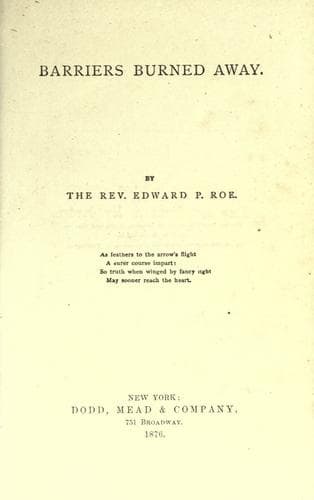
Chicago (Ill.) -- History -- To 1875 -- Fiction; Fires -- Fiction; Great Fire, Chicago, Ill., 1871 -- Fiction; Historical fiction
She sought to modify his towering hopes and rose-colored visions, but
to little purpose. Young, buoyant, in splendid health, with a surplus
of warm blood tingling in every vein, how could he take a prudent,
distrustful view of the world? It seemed to beckon him smilingly into
any path of success he might choose. Had not many won the victory? and
who ever felt braver and more determined than he, with the needs of
the dear ones at home added to his own incentives and ambitions? So,
with many embraces, lingering kisses, and farewell words, that lost
not their meaning though said over and over again, they parted. The
stage carried him to the nearest railway station, and the express train
bore him rapidly toward the great city where he expected to find all
that a man's heart most craves on earth.
Sanguine as his father, constant as his mother, with a nature that
would go right or wrong with tremendous energy, as direction might be
given it, he was destined to live no tame, colorless life, but would
either enjoy much, or else suffer much. To his young heart, swelling
with hopes, burning with zeal to distinguish himself and provide for
those he was leaving, even the bleak, snow-clad prairie seemed an arena
in which he might accomplish a vague something.
CHAPTER IV
COLD WATER
The train, somewhat impeded by snow, landed Dennis in Chicago at about
nine in the evening. In his pocket he had ten dollars--ample seed corn,
he believed, for a golden harvest. This large sum was expected to
provide for him till he should find a situation and receive the first
instalment of salary. He would inform his employer, when he found him,
how he was situated, and ask to be paid early and often.
Without a misgiving he shouldered the little trunk that contained his
worldly effects, and stalked off to a neighboring hotel, that, from
its small proportions, suggested a modest bill. With a highly important
man-of-the-world manner he scrawled his name in an illegible,
student-like hand on the dingy, dog-eared register. With a gracious,
condescending air he ordered the filthy, tobacco-stained porter to
take his trunk to his room.
The bar-room was the only place provided for strangers. Regarding the
bar with a holy horror, he got away from it as far as possible, and
seated himself by the stove, on which simmered a kettle of hot water
for the concoction of punches, apparently more in demand at that hotel
than beds. Becoming disgusted with the profanity and obscenity
downstairs, he sought refuge in the cold, miserable little room assigned
to him. Putting on his overcoat, he wrapped himself up in a coverlet
and threw himself down on the outside of the bed.
The night passed slowly. He was too uncomfortable, too excited, to
sleep. The scenes of the past blended confusedly with visions of the
future, and it was nearly morning when he fell into an unquiet slumber.
Public-domain text, read in full here on John Shaqi.
Reviews
Reviews
No reviews yet
Be the first to share your thoughts on this work.
Join the Discussion
Join the discussion
Sign in to leave a comment or review.
Sign InorCreate an account