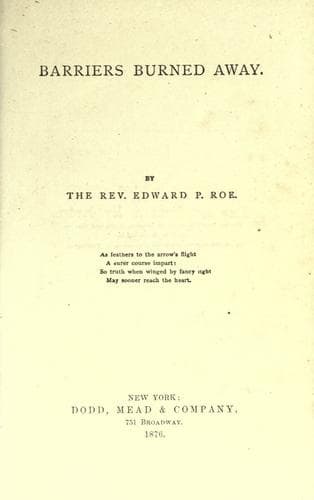
Chicago (Ill.) -- History -- To 1875 -- Fiction; Fires -- Fiction; Great Fire, Chicago, Ill., 1871 -- Fiction; Historical fiction
Many changes followed. Their farm was sold. Part of a small house in
the village of Bankville was rented as their future residence. A very
small annuity from some property in the East, left by Mrs. Fleet's
father, was, with Dennis's labor, all the family had to depend on
now--a meagre prospect.
But Dennis was very sanguine; for in this respect he had his father's
temperament. The world was all before him, and Chicago, the young and
giant city of the West, seemed an Eldorado, where fortune, and perhaps
fame, might soon be won. He would not only place the family beyond
want, but surround them with every luxury.
Dennis, wise and apt as far as his knowledge went, was in some respects
as simple and ignorant as a child. There were many phases and conditions
of society of which he had never dreamed. Of the ways of the rich and
fashionable, of the character of artificial life, he had not the
remotest experience. He could not see or understand the distinctions
and barriers that to the world are more impassable than those of
ignorance, stupidity, and even gross immorality. He would learn, to
his infinite surprise, that even in a Western democratic city men would
be welcomed in society whose hand no pure woman or honorable man ought
to touch, while he, a gentleman by birth, education, and especially
character, would not be recognized at all. He would discover that
wealth and the indorsement of a few fashionable people, though all
else were lacking, would be a better passport than the noblest qualities
and fine abilities. As we follow him from the seclusion of his simple
country home into the complicated life of the world, all this will
become apparent.
Long and earnest was the conversation between mother and son before
they separated. Pure and noble were the maxims that she sought to
instil into his mind. They may not have been worldly wise, but they
were heavenly wise. Though some of her advice in the letter might avail
little, since she knew less of the world than did her son, still in
its spirit it contained the best of all wisdom, profitable for this
life and the life to come. But she sent him forth to seek his fortune
and theirs with less solicitude than most mothers have just cause to
feel, for she knew that he had Christian principle, and had passed
through discipline that had sobered and matured him far beyond his
years. She saw, however, in every word and act his father's sanguine
temperament. He was expecting much, hoping far more, and she feared
that he also was destined to many a bitter disappointment. Still she
believed that he possessed a good strong substratum of common-sense,
and this combined with the lessons of faith and patience taught of God
would prove the ballast his father had lacked.
Public-domain text, read in full here on John Shaqi.
Reviews
Reviews
No reviews yet
Be the first to share your thoughts on this work.
Join the Discussion
Join the discussion
Sign in to leave a comment or review.
Sign InorCreate an account