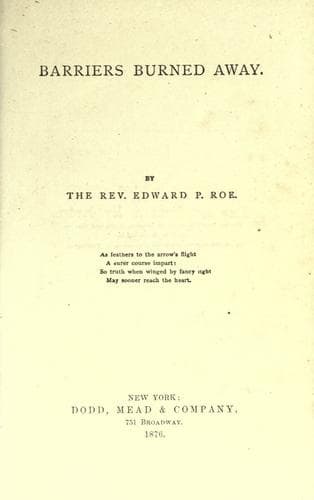
Chicago (Ill.) -- History -- To 1875 -- Fiction; Fires -- Fiction; Great Fire, Chicago, Ill., 1871 -- Fiction; Historical fiction
Everything, in contrast with the frozen, death-like cave, indicated
life, activity. Near her, a plane-tree, which in nature's language is
the emblem of genius, towered into the sky; around its trunk twined
the passion-flower, meaning, in Flora's tongue, "Holy love"; while
just above her head, sipping the nectar from an open blossom, was a
bright-hued butterfly, the symbol of immortality. By her side stood
the same tall, manly form, with face still averted. He was pointing,
and her eyes, softened, and yet lustrous and happy, were following
where a path wound through a long vista, in alternate light and shadow,
to a gate, that in the distance looked like a pearl. Above and beyond
it, in airy outline, rose the walls and towers of the Holy City, the
New Jerusalem.
For a long time she sat in rapt attention. Moment by moment the
paintings in their meaning grew upon her. At last her eyes filled with
tears, her bosom rose and fell with an emotion most unwonted, and in
low tones she murmured: "Heavenly delusion! and taught with the logic
I most dearly love. Oh, that I could believe it! I would give ten
thousand years of the life I am leading to know that it is true. Is
there, can there be a path that leads through light or shade to a final
and heavenly home? If this is true, in spite of all my father's keen
and seemingly convincing arguments, what a terrible mistake our life
is!"
Then her thoughts reverted to the artist.
"What have I done in driving him away with contempt in his heart for
me? I can no more affect haughty superiority to the man who painted
those pictures. Though he could not be my lover, what a friend he might
have been! I fear I shall never find his equal. Oh, this world of chaos
and confusion! What is right? What is best? _What is truth?_ He might
have taught me. But the skilful hand that portrayed those wonderful
scenes may soon turn to dust, and I shall go to my grave burdened with
the thought that I have quenched the brightest genius that will ever
shine upon me;" and she clasped her hands in an agony of regret.
Then came the thought of securing the pictures. Dropping a veil over
her red eyes, she went down and got some large sheets of paper, and
by fastening them together made a secure covering. Then she carried
the light frame with the canvas to the second floor, and, summoning
Ernst, started homeward with her treasure. The boy obeyed with
reluctance. Since the time she had surprised him out of his secret in
regard to the strawberries, he had never liked her, and now he felt
that in some way she was the cause of the sickness of his dearest
friend. Christine could not bear the reproach of his large, truthful
eyes, and their walk was a silent one. At parting she handed him a
banknote, but he shook his head.
"Have you heard from Mr. Fleet?" she asked, with a flush.
Public-domain text, read in full here on John Shaqi.
Reviews
Reviews
No reviews yet
Be the first to share your thoughts on this work.
Elsewhere in the archive
Join the Discussion
Join the discussion
Sign in to leave a comment or review.
Sign InorCreate an account