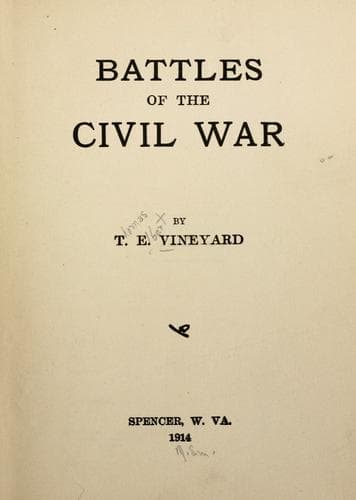
United States -- History -- Civil War, 1861-1865 -- Campaigns
Lee had counted on the arrival of A. P. Hill in time to help hold the
Federals in check at the bridge, but he was late and came up just in
time to save the army from disastrous defeat.
With the gloom of that night ended the conflict known as Antietam.
For fourteen hours more than 100,000 men, with 500 pieces of artillery,
had engaged in Titanic conflict. As the battle's smoke rose and
cleared away the scene presented was one to make the stoutest heart
shudder. There lay upon the ground, scattered for three miles over the
valleys and hills, and in the improvised hospitals, more than 20,000
men.
Horace Greeley was probably right when he said that this was the
bloodiest day in American history.
THE BATTLE OF MURFREESBORO
The fall months of 1862 had been spent by Generals Bragg and Buell in
racing across Kentucky, each at the head of a large army. Buell had
saved Louisville from the hands of the Confederates, while on the other
hand Bragg had succeeded in carrying away a large amount of plunder and
supplies for his army which he had gathered from the country through
which he passed, and of which his army was in great need.
The authorities at Washington became impatient with Buell on account
of his permitting the Confederate army to escape intact, and decided
to relieve him of the command of the army, which was handed to General
W. S. Rosecrans, who had won considerable distinction by his victories
at Corinth and other engagements in the West. The Union army was now
designated as the Army of the Cumberland.
Bragg was concentrating his army at Murfreesboro, in central Tennessee,
which was near Stone's River, a tributary of the Cumberland River.
On the last days of December General Bragg was advised of the Federals'
advance from Nashville, which is about thirty miles from Murfreesboro,
and he lost no time in taking position and getting his army into
well-drawn battle lines. His left wing under General Hardee, the
center Polk, and his right wing under Breckenridge, his cavalry
division was commanded by Generals Wheeler, Forrest and Morgan. His
lines were three miles in length. On December 30th the Federals came up
from Nashville and took position directly opposite in a parallel line.
The Federal left was commanded by Thos. L. Crittenden, whose brother
was a commander in the Confederate army, and were sons of a famous
United States senator from Kentucky. The Federal center was in command
of General George H. Thomas, and the right wing under General McCook.
Rosecrans had under his command about 43,000 men, while the strength of
the Confederates was about 38,000.
The two armies bivouacked within musket range of each other, and the
camp-fires of each were clearly seen by the other, as they shown
through the groves of trees.
It was plain to be seen that a deadly combat would begin with the
coming of the morning.
Public-domain text, read in full here on John Shaqi.
Reviews
Reviews
No reviews yet
Be the first to share your thoughts on this work.
Join the Discussion
Join the discussion
Sign in to leave a comment or review.
Sign InorCreate an account