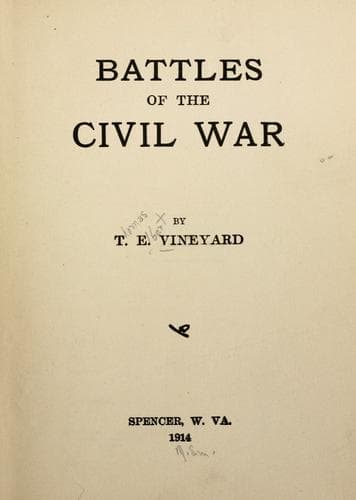
United States -- History -- Civil War, 1861-1865 -- Campaigns
Lee crossed the Potomac early in June, after leaving General Stuart
with his cavalry and a part of Hill's corps to prevent Hooker from
pursuing. He began to concentrate his army around Hagerstown, Md.,
and prepare for a campaign in Pennsylvania. His army was organized
into three corps under the respective commands of Longstreet, Ewell
and A. P. Hill. Lee had driven his army so as to enter Pennsylvania
by different routes, and to assess the towns along the way with large
sums of money. In the latter part of June Lee was startled by the
information that Stuart had failed to detain Hooker, and that the
Federals were in hot pursuit. He soon conceived that the two armies
must soon come together in a mighty death struggle, which meant that a
great battle must be fought, a greater battle than this western world
has heretofore known, which is claimed by historians as being one of
the decisive battles of the world.
The Army of the Potomac had changed leaders, and George Gordon Meade
was now its commander, having succeeded Hooker on June 28th. Thus
for the third time the Army of the Potomac in ten months had a new
commander.
The two great armies were scattered over portions of Maryland and
southern Pennsylvania. Both were marching northward along parallel
lines, the Federals endeavoring to stay between Lee's army and
Washington. It was plain that they must soon come together in a
gigantic conflict; but just where the shock of battle was to take place
was yet unknown.
Meade sent General Buford in advance with 4,000 cavalry to intercept
the Confederate advance guard.
On the night of June 30th Buford encamped on a hill a mile west from
Gettysburg, and here on the following morning the great battle had its
beginning.
On the morning of July 1st the two armies were still well scattered,
the extremes forty miles apart. General Reynolds, with two corps of the
Union army was but a few miles away and was hastening to Gettysburg,
while Longstreet and Hill were approaching from the west, with Hill's
corps several miles in advance.
Buford opened battle against the advance division of Hill's corps
under General Heth. Reynolds soon joined and the first day's battle was
now in full progress. General Reynolds, while placing his troops in
line of battle early in the day, received a death shot in the head by
a Confederate sharpshooter. This was a great loss to the Federals, as
he was one of the bravest and most able generals in the Union army. No
casualty of the war brought more widespread mourning to the North than
the death of General John F. Reynolds. But even this calamity did not
stay the fury of the battle.
Public-domain text, read in full here on John Shaqi.
Reviews
Reviews
No reviews yet
Be the first to share your thoughts on this work.
Join the Discussion
Join the discussion
Sign in to leave a comment or review.
Sign InorCreate an account