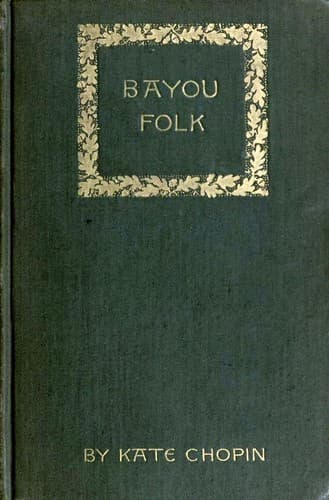
Louisiana -- Social life and customs -- Fiction; Short stories, American
"He is feeling easier, thank you, La Folle. Dr. Bonfils says it will be
nothing serious. He's sleeping now. Will you come back when he awakes?"
"_Non_, madame. I'm goin' wait yair tell Chéri wake up." La Folle
seated herself upon the topmost step of the veranda.
A look of wonder and deep content crept into her face as she watched
for the first time the sun rise upon the new, the beautiful world
beyond the bayou.
OLD AUNT PEGGY.
When the war was over, old Aunt Peggy went to Monsieur, and said:--
"Massa, I ain't never gwine to quit yer. I'm gittin' ole an' feeble,
an' my days is few in dis heah lan' o' sorrow an' sin. All I axes is a
li'le co'ner whar I kin set down an' wait peaceful fu de en'."
Monsieur and Madame were very much touched at this mark of affection
and fidelity from Aunt Peggy. So, in the general reconstruction of the
plantation which immediately followed the surrender, a nice cabin,
pleasantly appointed, was set apart for the old woman. Madame did not
even forget the very comfortable rocking-chair in which Aunt Peggy
might "set down," as she herself feelingly expressed it, "an' wait fu
de en'."
She has been rocking ever since.
At intervals of about two years Aunt Peggy hobbles up to the house, and
delivers the stereotyped address which has become more than familiar:--
"Mist'ess, I's come to take a las' look at you all. Le' me look at
you good. Le' me look at de chillun,--de big chillun an' de li'le
chillun. Le' me look at de picters an' de photygraphts an' de pianny,
an' eve'ything 'fo' it's too late. One eye is done gone, an' de udder's
a-gwine fas'. Any mo'nin' yo' po' ole Aunt Peggy gwine wake up an' fin'
herse'f stone-bline."
After such a visit Aunt Peggy invariably returns to her cabin with a
generously filled apron.
The scruple which Monsieur one time felt in supporting a woman for so
many years in idleness has entirely disappeared. Of late his attitude
towards Aunt Peggy is simply one of profound astonishment,--wonder at
the surprising age which an old black woman may attain when she sets
her mind to it, for Aunt Peggy is a hundred and twenty-five, so she
says.
It may not be true, however. Possibly she is older.
THE RETURN OF ALCIBIADE.
Mr. Fred Bartner was sorely perplexed and annoyed to find that a wheel
and tire of his buggy threatened to part company.
"Ef you want," said the negro boy who drove him, "we kin stop yonda at
ole M'sié Jean Ba's an' fix it; he got de bes' black-smif shop in de
pa'ish on his place."
"Who in the world is old Monsieur Jean Ba," the young man inquired.
"How come, suh, you don' know old M'sié Jean Baptiste Plochel? He ole,
ole. He sorter quare in he head ev' sence his son M'sié Alcibiade got
kill' in de wah. Yonda he live'; whar you sees dat che'okee hedge
takin' up half de road."
Public-domain text, read in full here on John Shaqi.
Reviews
Reviews
No reviews yet
Be the first to share your thoughts on this work.
Join the Discussion
Join the discussion
Sign in to leave a comment or review.
Sign InorCreate an account