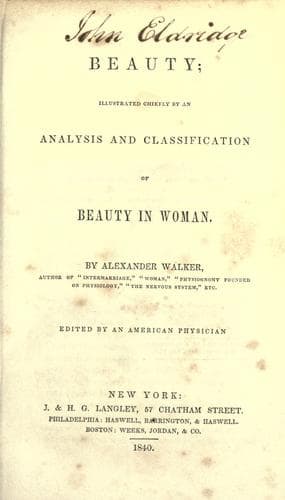
Beauty: Illustrated Chiefly by an Analysis and Classification of Beauty in WomanWalker, Alexander
Philosophy
Beauty: Illustrated Chiefly by an Analysis and Classification of Beauty in Woman
Walker, Alexander
Beauty, Personal; Women
In treating of the Elements of Beauty, I have endeavored to show, that the
more those simpler elements of beauty, which characterize inanimate
bodies, are retained in more compound ones, the more beautiful these
become; but that the latter retain these elements in very different
degrees, dependant upon internal or external circumstances, and that such
elementary beauty is often sacrificed to the higher ones of life or mind.
Now, in the case of the African, he is born whitish, like the European,
but he speedily loses such beauty for that of adaptation, by his color, to
the hot climate in which he exists. The latter beauty is the higher and
more important one, and forms for the African a profitable exchange; but
the European is still more fortunate, because, in the region he inhabits,
the simple and elementary beauty is compatible with that of adaptation to
climate. The climate of Africa, the cerebral structure of its inhabitants,
and the degree of their civilization, are as unfavorable to the existence
of beauty as to the power of judging respecting it. What he adds as to
variation in sable countenances is a mere exaggeration.
"Were it possible for a person to judge of the beauty of color in his own
species, upon the same principles and with the same impartiality as he
judges of it in other objects, both animal, vegetable, and mineral, there
can be no doubt that mixed teints would be preferred; and a pimpled face
have the same superiority over a smooth one, as a zebra has over an ass, a
variegated tulip over a plain one, or a column of jasper or porphyry over
one of a common red or white marble."
Here the same mistake is committed. Elementary beauty is preferred to that
of adaptation to climate, fitness for physiognomical expression, &c.
Knight's other arguments all involve similar errors, and admit of similar
answers.
CHAPTER XI.
THE THREE SPECIES OF FEMALE BEAUTY GENERALLY VIEWED.
These have been already briefly mentioned. They are repeated and
illustrated here.
The view which is given of them will throw light on the celebrated
temperaments of the ancients. It will appear that all the disputes which
have occurred respecting these, have arisen from their being founded, not
on precise data, but on empirical observation, at a time when the great
truths of anatomy and physiology were unknown; that, to the rectification
of the doctrine of temperaments, the arrangement of these sciences, laid
down in a preceding chapter, is indispensable; that some of these
temperaments are comparatively simple, and consist in an excessive or a
defective action of locomotive, nutritive, or thinking organs; that
others, which have been confounded with these, are, on the contrary,
compound; and that, from this want of classification, their nature has
been imperfectly understood.
To make this clear, it is necessary to lay before the reader a succinct
view of the doctrine of temperaments.
Public-domain text, read in full here on John Shaqi.
Reviews
Reviews
No reviews yet
Be the first to share your thoughts on this work.
Elsewhere in the archive
Join the Discussion
Join the discussion
Sign in to leave a comment or review.
Sign InorCreate an account