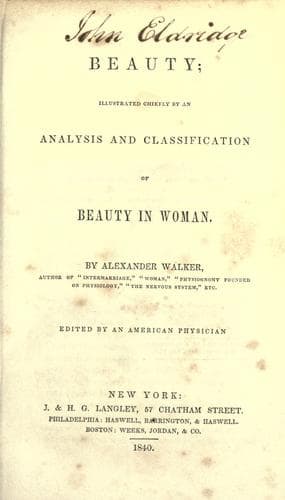
Beauty: Illustrated Chiefly by an Analysis and Classification of Beauty in WomanWalker, Alexander
Philosophy
Beauty: Illustrated Chiefly by an Analysis and Classification of Beauty in Woman
Walker, Alexander
Beauty, Personal; Women
"The formation of beauty was begun from some beautiful individual, that
is, from the imitation of some beautiful person, as in the representation
of some divinity. Even in the ages when the arts were flourishing, the
goddesses were formed from the models of beautiful women, and even from
those who publicly sold their charms: such was Theodota, of whom Xenophon
speaks. Nor was any one scandalized at it, for the opinion of the ancients
on these matters was very different from ours."
Winckelmann adds: "There is rarely or never, a body without fault, all the
parts of which are such that it is impossible to find or draw them more
perfect in other persons. The wisest artists, being aware of this ... did
not confine themselves to copying the forms of beauty from one individual
... but seeking what is beautiful from various objects, they endeavored to
combine them together, as the celebrated Parrhasius says in his discourse
with Socrates. Thus, in the formation of their figures, they were not
guided by any personal affections, by which we are frequently led, in the
pursuit of beauty that pleases us, to abandon true beauty.
"From the selection of the most beautiful parts and their harmonious union
in one figure, arises ideal beauty: nor is this a metaphysical idea,
because all the portions of the human figure taken separately are not
ideal; but merely the entire figure." And he elsewhere says: "It is called
ideal, not as regards its parts, but as a whole, in which nature can be
surpassed by art."
With deeper observation still, he adds that, "though nature tends to
perfection in the formation of individuals, yet she is so constantly
thwarted by the numerous accidents to which humanity is subject, that she
cannot attain the end proposed; so that it is in a manner impossible to
find an individual in whom all parts of the body are perfectly beautiful."
It was to the same purport that Proclus had in ancient times said: "He who
takes for his model such forms as nature produces, and confines himself
to an exact imitation of them, will never attain to what is perfectly
beautiful. For the works of nature are full of disproportion, and fall
very short of the true standard of beauty. So that Phidias, when he formed
his Jupiter, did not copy any object ever presented to his sight, but
contemplated only that image which he had conceived in his mind from
Homer's description."[46]
In short, while the Greek artists perpetually studied nature, they
discovered her best and highest tendencies even in her most perfect forms;
their works accordingly present nothing foreign to that which is strictly
beautiful; they present not only no inferior forms, but no idle ornaments;
and everything in them is accordingly at once simple and sublime.
Public-domain text, read in full here on John Shaqi.
Reviews
Reviews
No reviews yet
Be the first to share your thoughts on this work.
Elsewhere in the archive
Join the Discussion
Join the discussion
Sign in to leave a comment or review.
Sign InorCreate an account