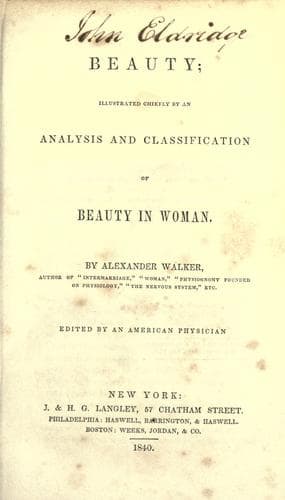
Beauty: Illustrated Chiefly by an Analysis and Classification of Beauty in WomanWalker, Alexander
Philosophy
Beauty: Illustrated Chiefly by an Analysis and Classification of Beauty in Woman
Walker, Alexander
Beauty, Personal; Women
Barry[47] affords me the means of continuing the view I now wish to
present. "In all individuals," he says, "of every species, there is
necessarily a visible tendency to a certain point or form. In this point
or form, the standard of each species rests. The deviations from this,
either by excess or deficiency, are of two kinds: first, deviations
indicating a more peculiar adaptation of certain characters of advantage
and utility, such as strength, agility, and so forth; even mental as well
as corporeal, since they sometimes result from habit and education, as
well as from original conformation. In these deviations, are to be found
those ingredients which, in their composition and union, exhibit the
abstract or ideal perfection in the several classes or species of
character. The second kind of deviation is that which, having no reference
to anything useful or advantageous, but rather visibly indicating the
contrary, as being useless, cumbersome, or deficient, is considered as
deformity; and this deformity will be always found different in the
several individuals, by either not being in the same part, in the same
manner, or in the same degree. The points of agreement which indicate the
species, are therefore many; of difference which indicate the deformity,
few."
Barry, however, wrongly says: "Mere beauty, then, though always
interesting, is, notwithstanding, vague and indeterminate; as it indicates
no particular expression either of body or mind." But it indicates the
highest character, the capability of all noble expression, and this is
better than its sacrifice to actuality in one.
I am now led to the greater rules which their ideal method suggested to
the Greeks. Payne Knight indeed says: "Precise rules and definitions, in
matters of this sort, are merely the playthings or tools of
system-builders;" and, unchecked by any recollection of the practical and
unrivalled excellence of the founders of these rules, he adds a great deal
of narrow-minded and mistaken nonsense upon the subject, never
distinguishing between rules in themselves rational, and the stretching of
them to utter inapplicability. On this subject, even Reynolds properly
observes, that "some of the greatest names of antiquity, and those who
have most distinguished themselves in works of genius and imagination,
were equally eminent for their critical skill. Plato, Aristotle, Cicero,
and Horace; and among the moderns, Boileau, Corneille, Pope, and Dryden,
are at least instances of genius not being destroyed by attention or
subjection to rules and science."
Public-domain text, read in full here on John Shaqi.
Reviews
Reviews
No reviews yet
Be the first to share your thoughts on this work.
Elsewhere in the archive
Join the Discussion
Join the discussion
Sign in to leave a comment or review.
Sign InorCreate an account