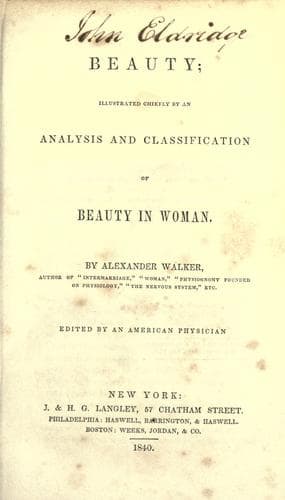
Beauty: Illustrated Chiefly by an Analysis and Classification of Beauty in Woman — John Shaqi
Beauty: Illustrated Chiefly by an Analysis and Classification of Beauty in WomanWalker, Alexander
Philosophy
Beauty: Illustrated Chiefly by an Analysis and Classification of Beauty in Woman
Walker, Alexander
Beauty, Personal; Women
The works of all travellers afford the same illustrations of this fact. I
quote one. Kotzebue describes the custom among the Tartar women of Kasan,
of flying or of concealing their countenance from the sight of a stranger.
The necessity of conforming to this custom threw into great embarrassment
a young woman who was obliged to pass several times before the German
traveller. She at first concealed her face with her hands; but, soon
embarrassed by that attitude, she removed the veil which covered her
bosom, and threw it over her face. "That," adds Kotzebue, "was, as we say,
uncovering Paul to cover Jacques: the bosom remained naked. To cover that,
she next showed what should have been concealed; and if anything escaped
from her hands, she stooped, and then," says Kotzebue, "I saw both one
and the other."
In colder or more uncertain climates, the greatest degree of covering
constitutes the greatest degree of artificial decency: fashion and decency
are confounded. Among old-fashioned people, of whom a good example may be
found in old countrywomen of the middle class in England, it is indecent
to be seen with the head unclothed; such a woman is terrified at the
chance of being seen in that condition; and if intruded on at such a time,
she shrieks with terror and flies to conceal herself. In the equally
polished dandy of the metropolis, it is indecent to be seen without
gloves. Which of these respectable creatures is the most enlightened, I do
not take upon me to say; but I believe that the majority of suffrages
would be in favor of the old woman.
So entirely are these decencies artificial, that any number of them may
easily be created, not merely with regard to man or woman, but even with
regard to domesticated animals. If it should please some persons partially
to clothe horses, cows, or dogs, it would ere long be felt that their
appearing in the streets without trowsers or aprons was grossly indecent.
We might thus create a real feeling of indecency, the perception of a new
impurity, which would take the place of the former absence of all impure
thought, and once established, the evil would be as real as our whims have
made it in other respects.
Moral feeling is deeply injured by this substitution of impure thoughts,
however fancifully founded, for pure ones, or rather for the entire
absence of thought about worthless things. Artificial crimes are thus
made, which are not the less real because artificial; for if aught of this
kind is believed to be right, there is weakness or wrong in its violation.
But violated it must be, if it were but accidentally.
To corrupt minds, this very violation of artificial decency in the case of
woman affords the zest for the sake of which many of these decencies seem
to have been instituted; and thus are created the artful decencies.
Public-domain text, read in full here on John Shaqi.
Reviews
Reviews
No reviews yet
Be the first to share your thoughts on this work.
Join the Discussion
Join the discussion
Sign in to leave a comment or review.
Sign InorCreate an account