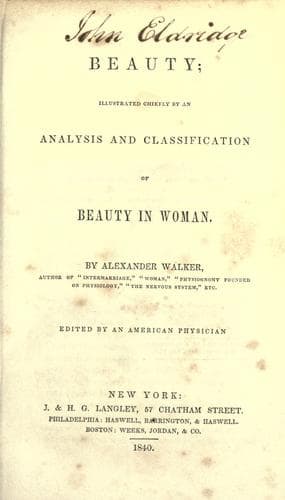
Beauty: Illustrated Chiefly by an Analysis and Classification of Beauty in WomanWalker, Alexander
Philosophy
Beauty: Illustrated Chiefly by an Analysis and Classification of Beauty in Woman
Walker, Alexander
Beauty, Personal; Women
Home observes that "the sense of beauty does not tend to advance the
interests of society, but when in a due mean with respect to strength.
Love in particular arising from a sense of beauty, loses, when excessive,
its sociable character: the appetite for gratification, prevailing over
affection for the beloved object, is ungovernable, and tends violently to
its end, regardless of the misery that must follow. Love in this state is
no longer a sweet agreeable passion: it becomes painful, like hunger or
thirst, and produces no happiness but in the instant of fruition. This
discovery suggests a most important lesson, that moderation in our desires
and appetites, which fits us for doing our duty, contributes at the same
time the most to happiness: even social passions, when moderate, are more
pleasant than when they swell beyond proper bounds." Payne Knight says:
"When, at the age of puberty, animal desire obtrudes itself on a mind
already qualified to feel and enjoy the charms of intellectual merit, the
imagination immediately begins to form pictures of perfection, by
exaggerating and combining in one hypothetic object every excellence that
can possibly belong to the whole sex; and the first individual that meets
the eye, with any exterior signs of any of these ideal excellences, is
immediately decorated with them all, by the creative magic of a vigorous
and fertile fancy. Hence, she instantaneously becomes the object of the
most fervent affection, which is as instantaneously cooled by possession:
for, as it was not the object herself, but a false idea of her raised in
heated imagination, that called forth all the lover's raptures, all
immediately vanish at the detection of his delusion; and a degree of
disgust proportioned to the disappointment, of which it is the inevitable
consequence, instantly succeeds. Thus it happens that what are called
love-matches are seldom or ever happy."
Now, nothing can more effectually prevent even the existence of the mania
described by these two philosophers than a critical judgment and a pure
taste for beauty, which again therefore are the sole protection against
low and degrading connexions.
A just sense of this truth will give high encouragement to sculpture and
painting--arts which may everywhere be looked upon as the best tests, as
well as the best records, of civilization. Such encouragement they need in
truth; for the monstrous monopoly of landed property and the accumulation
of wealth in few hands--the great aim of our political economy--renders
art poor, indeed.
I am aware that the vulgar among artists think otherwise; from the few
rich they obtain employment; and, like the dog with his master, they look
not beyond the hand that doles out their pittance. But the rich are few;
and their palaces are already filled. A diffusion of wealth alone can give
encouragement to art; nor can this ever be while British industry is
crushed under the weight of enormous taxation.
Public-domain text, read in full here on John Shaqi.
Reviews
Reviews
No reviews yet
Be the first to share your thoughts on this work.
Join the Discussion
Join the discussion
Sign in to leave a comment or review.
Sign InorCreate an account