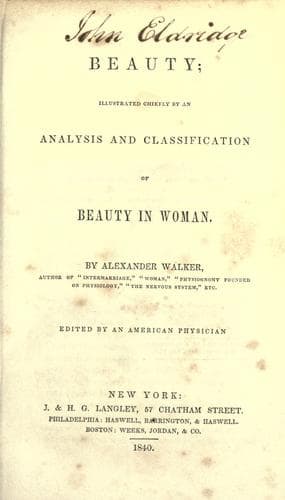
Beauty: Illustrated Chiefly by an Analysis and Classification of Beauty in WomanWalker, Alexander
Philosophy
Beauty: Illustrated Chiefly by an Analysis and Classification of Beauty in Woman
Walker, Alexander
Beauty, Personal; Women
Having removed some objections to art, I would add a few words to artists
on the cause of the fine arts in Greece, from a paper I, two years ago,
contributed to a monthly periodical.[4]
That the mythology of Greece had an influence over its arts, is generally
granted; but I am not aware, that it has either been shown to be
exclusively their cause, or that its mode of operation has ever been
explained.
Religion, I may observe, is as natural to man as his weakness and
helplessness. There is not one of its systems, not even the vilest, which
has not afforded him consolation. Of its higher and better systems, some
are equally admirable for the grandeur and the beauty of the truths on
which they are founded, the simplicity and the elegance of their
ostensible forms, the power and applicability of their symbols, and their
sympathy with, and control over, the affections and the imagination.
These high characteristics peculiarly distinguished the religion of
ancient Greece.
By bigots, we are indeed told, that, though Homer is our model in epic,
Anacreon in lyric, and Æschylus in dramatic poetry--though the music of
Greece doubtless corresponded to its poetry in beauty, pathos, and
grandeur--though the mere wreck of her sculpture is never overlooked in
modern war and negotiation--though the mere sight of her ruined Parthenon
is more than a reward for the fatigue or the peril of a journey to the
Eternal city--though these products of art are the test of the highest
civilization which the world has witnessed--though to these chiefly Rome
owed the little civilization of which she was capable, and we ourselves
the circumstance that, at this hour, we are not, like our ancestors,
covered only with blue paint or the skins of brutes--though all this is
true as to the arts of Greece, we are told that, by the strangest
exception, the religion of Greece was a base superstition.
That religion, however, was the creator of these arts. They not only could
not have existed without it, but they probably could never have been
called into existence by any other religion.
Public-domain text, read in full here on John Shaqi.
Reviews
Reviews
No reviews yet
Be the first to share your thoughts on this work.
Join the Discussion
Join the discussion
Sign in to leave a comment or review.
Sign InorCreate an account