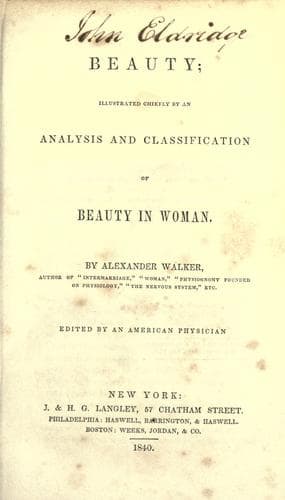
Beauty: Illustrated Chiefly by an Analysis and Classification of Beauty in WomanWalker, Alexander
Philosophy
Beauty: Illustrated Chiefly by an Analysis and Classification of Beauty in Woman
Walker, Alexander
Beauty, Personal; Women
Speaking of beauty generally, and without seeing the distinctions I have
made above, Burke, on the contrary, states the first quality of beauty to
be comparative smallness, and says: "In ordinary conversation, it is usual
to add the endearing name of little to everything we love;" and "in most
languages, the objects of love are spoken of under diminutive epithets."
This is evidently true only of the objects of _minor_ or _subordinate
beauty_, which Burke confusedly thought the only kind of it, though he
elsewhere grants, that beauty may be connected with sublimity! It shows,
however, that relative littleness is essential to that first kind of
beauty.
With greater knowledge of facts than Burke possessed, and with as feeble
reasoning powers, but with less taste, and with a perverse whimsicality
which was all his own, Payne Knight similarly, making no distinction in
beauty, considered smallness as an accidental association, failed to see
that it characterized a kind of beauty, and argued, that "if we join the
diminutive to a term which precludes all such affection, or does not even,
in some degree, express it, it immediately converts it into a term of
contempt and reproach: thus, a bantling, a fondling, a darling, &c., are
terms of endearment; but a witling, a changeling, a lordling, &c., are
invariably terms of scorn: so in French, '_mon petit enfant_,' is an
expression of endearment; but '_mon petit monsieur_,' is an expression of
the most pointed reproach and contempt."
Now, this chatter of grammatical termination and French phrase, though
meant to look vastly clever, is merely a blunder. There is no analogy in
the cases compared: a "darling" or little dear unites _dear_, an
expression of love, with _little_, implying that dependance which enhances
love; while "witling" or little wit unites _wit_, an expression of talent,
with _little_, meaning the small quantity or absence of the talent alluded
to; and it is because the latter term means, not physical littleness,
which well associates with love, but moral littleness and mental
degradation, that it becomes a term of contempt.
Even from the little already said, it seems evident that much of the
confusion on this subject has arisen from not distinguishing the two
genera of beauty, and not seeing that "the emotion of grandeur" is merely
"a branch of the emotion of beauty."
The other genus of beauty, _grand_ or _sublime beauty_, is well described
by the names given to it, grandeur or sublimity. Some have considered
sublimity as expressing grandeur in the highest degree: it would perhaps
be as well to express the cause of the emotion by grandeur, and the
emotion itself by sublimity.
Nothing is sublime that is not vast or powerful, or that does not make him
who feels it sensible of its physical or moral superiority.
Public-domain text, read in full here on John Shaqi.
Reviews
Reviews
No reviews yet
Be the first to share your thoughts on this work.
Join the Discussion
Join the discussion
Sign in to leave a comment or review.
Sign InorCreate an account