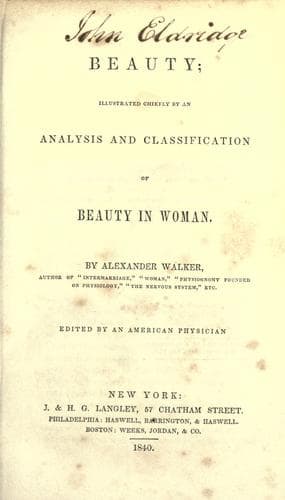
Beauty: Illustrated Chiefly by an Analysis and Classification of Beauty in WomanWalker, Alexander
Philosophy
Beauty: Illustrated Chiefly by an Analysis and Classification of Beauty in Woman
Walker, Alexander
Beauty, Personal; Women
The simplest cause of sublimity is presented by all objects of vast
magnitude or extent--a seemingly boundless plain, the sky, the ocean,
&c.; and the particular direction of the magnitude or extent always
correspondingly modifies the emotion--height giving more especially the
idea of power, breadth of resistance, depth of danger, &c. Of the objects
mentioned above, the ocean is the most sublime, because, to vastness in
length and breadth, it adds depth, and a force perpetually active.
Now, that these objects, though sublime, are beautiful, is very evident;
and it is therefore also evident how much Burke erred in asserting
comparative smallness to be the first character of beauty generally
considered. This and similar errors, as already said, have greatly
obscured this subject, and have led Burke and others so to modify and
qualify their doctrines, as to take from them all precision and certainty.
Hence, in one place, Burke says: "As, in the animal world, and in a good
measure in the vegetable world likewise, the qualities that constitute
_beauty_ may _possibly_ be united to things of _greater dimensions_ [that
is, littleness may be united with bigness!]; when they are so united they
constitute _a species something different both from the sublime and
beautiful_, which I have before called, Fine."
So also he says: "Ugliness I imagine likewise to be consistent enough with
an idea of the sublime. But I would by no means insinuate that ugliness of
itself is a sublime idea, unless united with such qualities as excite a
strong terror."
Here, he confounds sublimity with terror, as do Blair and other writers,
when they say that "exact proportion of parts, though it enters often
into the beautiful, is much disregarded in the sublime." It is a fact,
that exactly in proportion as ugliness is substituted for beauty in vast
objects, is sublimity taken away, until at last it is utterly lost in the
terrible.
Even Blair shows that sublimity may exist without terror or pain. "The
proper sensation of sublimity appears," he observes, "to be
distinguishable from the sensation of either of these, and, on several
occasions, to be entirely separated from them. In many grand objects,
there is no coincidence with terror at all; as in the magnificent prospect
of wide-extended plains, and of the starry firmament; or in the moral
dispositions and sentiments, which we view with high admiration; and in
many painful and terrible objects also, it is clear, there is no sort of
grandeur. The amputation of a limb, or the bite of a snake, is exceedingly
terrible, but is destitute of all claim whatever to sublimity."
Public-domain text, read in full here on John Shaqi.
Reviews
Reviews
No reviews yet
Be the first to share your thoughts on this work.
Join the Discussion
Join the discussion
Sign in to leave a comment or review.
Sign InorCreate an account