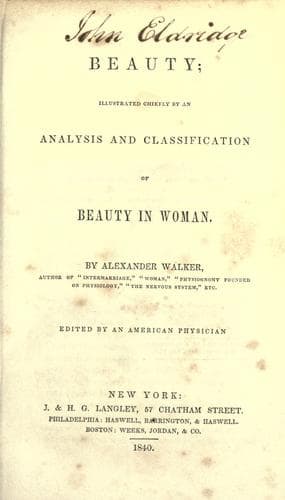
Beauty: Illustrated Chiefly by an Analysis and Classification of Beauty in WomanWalker, Alexander
Philosophy
Beauty: Illustrated Chiefly by an Analysis and Classification of Beauty in Woman
Walker, Alexander
Beauty, Personal; Women
As, then, from all that has been said, it appears that all the elements of
beauty which have thus been noticed, belong to inanimate beings, and as
this is shown by the passages I have quoted from the best writers, it
seems surprising, not merely that they should not have seen this to be the
case, but, that it should not have led them to observe, that there exists
also a second beauty, of living beings, and third, of thinking beings, as
well as others of the useful, the ornamental, and the intellectual arts
respectively, in each of which some new element was only added to the
characters of the preceding species.
It seems still more surprising that Alison, who deviates so widely from
all fundamental principles, should have actually stumbled upon an
observation of a few of the characteristics of inanimate beings, and
traced them as they pass upward through some living and thinking
beings--whose new characteristics, however, he did not discriminate. He
observes, that "the greater part of those bodies in nature, which possess
hardness, strength, or durability, are distinguished by angular forms. The
greater part of those bodies, on the contrary, which possess weakness,
fragility, or delicacy, are distinguished by winding or curvilinear forms.
In the mineral kingdom, all rocks, stones, and metals, the hardest and
most durable bodies we know, assume universally angular forms. In the
vegetable kingdom, all strong and durable plants are in general
distinguished by similar forms. The feebler and more delicate race of
vegetables, on the contrary, are mostly distinguished by winding forms. In
the animal kingdom, in the same manner, strong and powerful animals are
generally characterized by angular forms; feeble and delicate animals, by
forms of the contrary kind."[13]
SECTION II.
ELEMENTS OF BEAUTY IN LIVING BEINGS.
I have now to show that, in living beings, while the characters of the
first and fundamental beauty, that of inanimate beings, are still
partially continued, new characteristics are added to them.
Plants accordingly possess both rigid parts, like some of those described
in the preceding section, and delicate parts, which, in ascending through
the classes of natural beings from the simplest to the most complex, are
the very first to present to us new and additional characters totally
distinct from those of the preceding class.
I. To begin as nature does, then, we find the trunks and stems of plants,
which are near the ground, resembling most in character the inanimate
bodies from among which they spring. They assume the simplest and most
universal form in nature, the round one; but as growth is their great
function, they extend in height and become cylindrical.
Public-domain text, read in full here on John Shaqi.
Reviews
Reviews
No reviews yet
Be the first to share your thoughts on this work.
Elsewhere in the archive
Join the Discussion
Join the discussion
Sign in to leave a comment or review.
Sign InorCreate an account