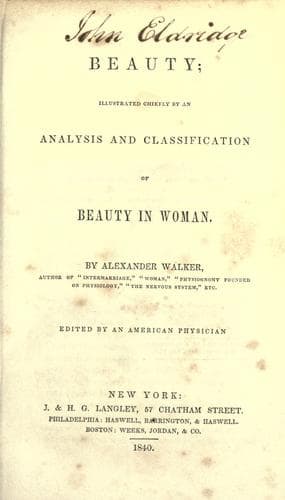
Beauty: Illustrated Chiefly by an Analysis and Classification of Beauty in WomanWalker, Alexander
Philosophy
Beauty: Illustrated Chiefly by an Analysis and Classification of Beauty in Woman
Walker, Alexander
Beauty, Personal; Women
Even the branches, the twigs, and the tendrils, continue this elementary
character; but it is in them, or in the stem when, like them, it is
tender, that such elementary characters give way to the purposes of life,
namely, growth and reproduction, and that we discover the new and
additional characters of beauty which this class presents to us.
II. To render this matter plain, I must observe that the formation of
rings, which unite in tubes, appears to be almost universally the material
condition of growth and reproduction. Every new portion of these tubes,
moreover, and every superadded ring, is less than that which preceded it.
It is from this that results the first characteristic of this second kind
of beauty, namely, fineness or delicacy. Hence, Burke made the possession
of a delicate frame, without any remarkable appearance of strength, his
fifth condition in beauty; and he here erred only from that want of
discrimination which led him to confound together all the conditions of
beauty, and prevented his seeing that they belonged to different genera.
Now, as fine and delicate bodies, which are growing, will shoot in that
direction where space, air, and light, can best be had, and as this, amid
other twigs and tendrils, will greatly vary, so will their productions
rarely continue long in the same straight line, but will, on the contrary,
bend. Hence, the curved or bending form is the second characteristic of
this kind of beauty.
It is worthy of remark, that, as the trunks, stems, twigs, and tendrils,
of plants assume the simplest and most universal form in nature, the round
one, so their more delicate parts have again the tendency to bend into a
similar form.
In the young and feeble branches of plants, it is observed by Alison, that
the bending form is "beautiful, when we perceive that it is the
consequence of the delicacy of their texture, and of their being
overpowered by the weight of the flower.... In the smaller and feebler
tribe of flowers, as in the violet, the daisy, or the lily of the valley,
the bending of the stem constitutes a very beautiful form, because we
immediately perceive that it is the consequence of the weakness and
delicacy of the flower."
From the circumstances now described, it results that all the parts of
plants present the most surprising variety. They vary their direction
every moment, as Burke observes, and they change under the eye by a
deviation continually carrying on, but for whose beginning or end you will
find it difficult to ascertain a point.
Variety is therefore the third characteristic of this second kind of
beauty; and in the indiscriminating views of Burke, he made two similar
conditions, viz: "Thirdly, to have a variety in the direction of the
parts; but, fourthly, to have those parts not angular, but melted as it
were into each other;" thus applying these to beauty generally, to which
they are not applicable, but in a confused and imperfect way.
Public-domain text, read in full here on John Shaqi.
Reviews
Reviews
No reviews yet
Be the first to share your thoughts on this work.
Elsewhere in the archive
Join the Discussion
Join the discussion
Sign in to leave a comment or review.
Sign InorCreate an account