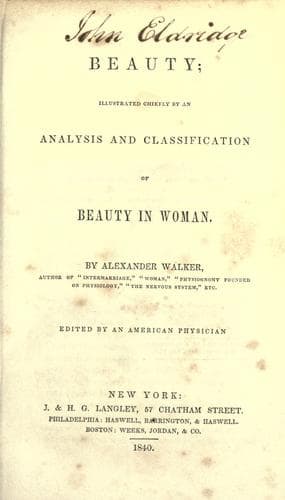
Beauty: Illustrated Chiefly by an Analysis and Classification of Beauty in WomanWalker, Alexander
Philosophy
Beauty: Illustrated Chiefly by an Analysis and Classification of Beauty in Woman
Walker, Alexander
Beauty, Personal; Women
I divide the arts into the useful, the ornamental, and the intellectual,
commonly called the fine arts; and I shall endeavor to show, that the
objects of each of these are characterized by a peculiar kind of beauty,
corresponding to one of those already described.
I shall endeavor to show that the objects of the useful arts are
characterized by the simple geometrical forms which belong to inanimate
beings; that those of the ornamental arts are characterized by the
delicate, bending, varied, and contrasted forms of living beings; and that
those of the intellectual arts are, in their highest efforts,
characterized chiefly by thinking forms, as in gesture, sculpture,
painting, or by functions of mind actually exercised, in oratory, poetry,
music.
In all these arts, purpose is implied--not purpose in the hypothetical
sense, as applied to the existence, conditions, and objects, of natural
beings--but in the common intelligible sense of the word, as expressing
the intention of men in the pursuit of these arts.
_Beauty of Useful Objects._
Here the purpose being utility, this kind of beauty arises from the
perception of means as adapted to an end, which of course implies, the
parts of anything being fitted to answer the purpose of the whole.
This implies an act of understanding and judgment; for of no product of
useful art can we perceive the extrinsic beauty, until we know its
destination, and the relations which that involves.
When these are known, so powerful is the sense of utility, that, though
deviation from the elementary beauty never ceases to be felt, yet that
sense sanctions it to a great extent. Hence it is that an irregular
dwelling-house may become beautiful, when its convenience is striking.
Hence it is that, in the forms of furniture, machines, and instruments,
their beauty arises chiefly from this consideration; and that every form
becomes beautiful by association, where it is perfectly adapted to its
end.
The greater, however, the elementary beauty, that can be introduced in
useful objects, the more obvious will their utility be, and the more
beautiful will they universally appear. This will be granted the moment I
mention simplicity.
Of all the elements of beauty already spoken of--of all the means of
producing accordant and agreeable relations--simplicity appears to be the
most efficient; and in all the useful arts, no elementary consideration
recommends their objects so much.
This implies all the rest, regularity, uniformity, proportion, order, &c.,
as far as is compatible with purpose.
Thus, in regard to uniformity, says some one, a number of things destined
for the same purpose, as chairs, spoons, &c., cannot be too uniform,
because they are adapted to uniform purposes; but it would be absurd to
give to objects destined for one purpose the form suited to those destined
for another.
Public-domain text, read in full here on John Shaqi.
Reviews
Reviews
No reviews yet
Be the first to share your thoughts on this work.
Elsewhere in the archive
Join the Discussion
Join the discussion
Sign in to leave a comment or review.
Sign InorCreate an account