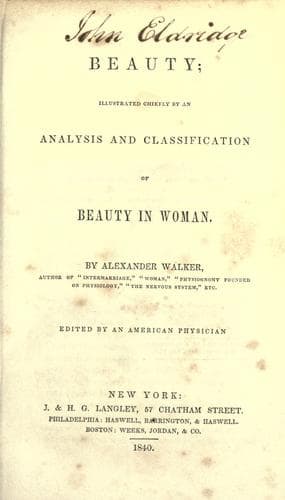
Beauty: Illustrated Chiefly by an Analysis and Classification of Beauty in WomanWalker, Alexander
Philosophy
Beauty: Illustrated Chiefly by an Analysis and Classification of Beauty in Woman
Walker, Alexander
Beauty, Personal; Women
So also the objects of useful art will resemble in form precisely as they
resemble in purpose; and where the purpose is similar, and the deviation
which is admissible is slight, this becomes a subject of great nicety,
and, if ornament be at the same time admissible, a subject of exquisite
taste.
It was by the transcendent exercise of these qualities, that the Greeks
succeeded in fixing the orders of architecture. The most beautiful columns
would have shocked the sight, if their mass had not corresponded to that
of the edifice which they sustained; and the difference which existed in
this respect, required a difference of ornament.
Home indeed observes, that "writers on architecture insist much upon the
proportions of a column, and assign different proportions to the Doric,
Ionic, and Corinthian; but no architect will maintain, that the most
accurate proportions contribute more to use, than several that are less
accurate and less agreeable."
That such a man should have committed such an error is surprising. It
seems evident that the different proportion in the columns of these orders
is admirably suited to the different quantity of matter in their
entablatures. A greater superincumbent mass, required shorter and thicker
columns; a less superincumbent mass, longer and slender ones. Many
experiments, much observation, were requisite to determine this; but the
Greeks had the means of making them, and solved every problem on the
subject; and the result of the perfection they attained is, that all err
who depart from the truth they have determined.
It was, again, the differing quantities of matter in the entablatures, and
the accurately-corresponding dimensions of the columns that determined, of
course amid infinite experiment and observation, the nature of their
ornaments. Hence, the Doric is distinguished by simplicity; the Ionic by
elegance; and the Corinthian by lightness, in ornament as well as in
proportion.
Even, therefore, if we were to destroy all the associations of elegance,
of magnificence, of costliness, and, still more than all, of antiquity,
which are so strongly connected with such forms, the pleasure which their
proportions would afford, would remain, as in all cases where means are
best adapted to their end.
In his objections to proportion as an element of beauty, Burke only
confounds this kind of beauty with that which I have next to describe.
Public-domain text, read in full here on John Shaqi.
Reviews
Reviews
No reviews yet
Be the first to share your thoughts on this work.
Elsewhere in the archive
Join the Discussion
Join the discussion
Sign in to leave a comment or review.
Sign InorCreate an account