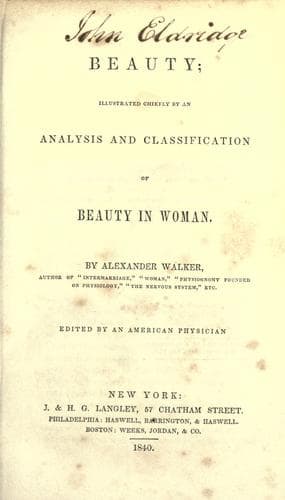
Beauty: Illustrated Chiefly by an Analysis and Classification of Beauty in WomanWalker, Alexander
Philosophy
Beauty: Illustrated Chiefly by an Analysis and Classification of Beauty in Woman
Walker, Alexander
Beauty, Personal; Women
"The effects of proportion and fitness," he says, "at least so far as they
proceed from a mere consideration of the work itself, produce approbation,
the acquiescence of the understanding, but not love, nor any passion of
that species. When we examine the structure of a watch, when we come to
know thoroughly the use of every part of it, satisfied as we are with the
fitness of the whole, we are far enough from perceiving anything like
beauty in the watchwork itself; but let us look on the case, the labor of
some curious artist in engraving, with little or no idea of use, we shall
have a much livelier idea of beauty than we ever could have had from the
watch itself, though the masterpiece of Graham."
It is an emotion of pleasure which is the inevitable result of the
perception of beauty, not love, nor any passion of the kind. These will or
will not follow, according to the nature of the object, and of the mind of
the observer. A hill, a valley, or a rivulet, may be beautiful, and it
will excite an emotion of pleasure when its beauty is discerned; but it
may produce no desire or passion of love. There may exist, then, the
beauty of utility, as to the structure of the watch, and that of ornament
as to its case; and some minds will more readily perceive the one; others,
the other.
When Burke adds, "In beauty, the effect is previous to any knowledge of
the use; but to judge of proportion, we must know the end for which any
work is designed;" he forgets, that, in the instance of the barber's
block, &c., he showed that the perception of beauty, as well as
proportion, required observation, experience, and reflection.
_Beauty of Ornamental Objects._
There are three great arts which, under circumstances of high
civilization, become ornamental, namely, landscape-gardening,
architecture, and dress--the particular arts by which our persons are more
or less closely invested;[14] and all of them, then, require beauty of the
second kind, that which belongs particularly to vegetable beings, and is
characterized by delicate, bending varied, and contrasted forms.
All these, regarded as ornamental arts, have chiefly bodily and sensual
pleasures for their purpose; and this I consider as distinguishing them
from the intellectual arts, which have a higher purpose.
Of landscape-gardening, the materials are plants, and therefore its beauty
is evidently dependant on, or rather composed of, theirs.
The same kind of beauty will be found in every ornamental art. Hence,
Alison says: "The greater part of beautiful forms in nature, are to be
found in the vegetable kingdom, in the forms of flowers, of foliage, of
shrubs, and in those assumed by the young shoots of trees. It is from
them, accordingly, that almost all those forms have been imitated, which
have been employed by artists for the purposes of ornament and elegance."
Public-domain text, read in full here on John Shaqi.
Reviews
Reviews
No reviews yet
Be the first to share your thoughts on this work.
Elsewhere in the archive
Join the Discussion
Join the discussion
Sign in to leave a comment or review.
Sign InorCreate an account