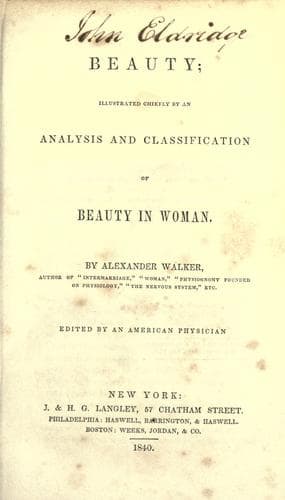
Beauty: Illustrated Chiefly by an Analysis and Classification of Beauty in WomanWalker, Alexander
Philosophy
Beauty: Illustrated Chiefly by an Analysis and Classification of Beauty in Woman
Walker, Alexander
Beauty, Personal; Women
On this kind of beauty, mistaking it for the only one, Hogarth founded his
peculiar doctrine. "He adopts two lines, on which, according to him, the
beauty of figure principally depends. One is the waving line, or a curve
bending gently in opposite directions. This he calls the line of beauty;
and he shows how often it is found in flowers, shells, and various works
of nature; while it is common also in the figures designed by painters and
sculptors, for the purpose of decoration. The other line, which he calls
the line of grace, is the former waving line, twisted round some solid
body. Twisted pillars and twisted horns exhibit it. In all the instances
which he mentions, variety plainly appears to be so important an element
of this kind of beauty, that he states a portion of the truth, when he
defines the art of drawing pleasing forms to be the art of varying well;
for the curve line, so much the favorite of painters, derives much of its
beauty from its perpetual bending and variation from the stiff regularity
of the straight line." It is evident, however, that in this, he mistakes
one kind of beauty for all.
Of architecture, considered as a fine art, much of the beauty depends on
the imitation of vegetable forms. Employing materials which require the
best characteristics of the first kind of beauty, it, in its choicest and
ornamented parts, imitates both the rigid trunks, and the delicate and
bending forms of plants. Its columns, tapering upward, are copied from the
trunks of trees; and their decorations are suited with consummate art to
their dimensions, and the weight they support. The simple Doric has little
ornament; the elegant Ionic has more; the light Corinthian has most.
On the subject of these finely-calculated ornaments, some observations
have struck me, which I have not seen mentioned elsewhere. The Doric
presents only columns, without any other ornament than that of which their
mere form admits. The Ionic expresses increased lightness, by the
interposition of its volute, as if the superincumbent weight had but
gently pressed a soft solid into a scroll. The Corinthian expresses the
utmost lightness, by forming its capitals of foliage, as if the weight
above them could not crush even a leaf. The Composite expresses gayety, by
adding flowers to the foliage. It is from imperfect views of this, that
the meaning and effect of caryatides have been mistaken: instead of being
oppressed by weight, they seem, when well employed, to have no weight to
support.
In nearly all internal architectural decorations, it is the delicate,
bending, varied, and contrasted vegetable forms which are imitated.
Public-domain text, read in full here on John Shaqi.
Reviews
Reviews
No reviews yet
Be the first to share your thoughts on this work.
Elsewhere in the archive
Join the Discussion
Join the discussion
Sign in to leave a comment or review.
Sign InorCreate an account