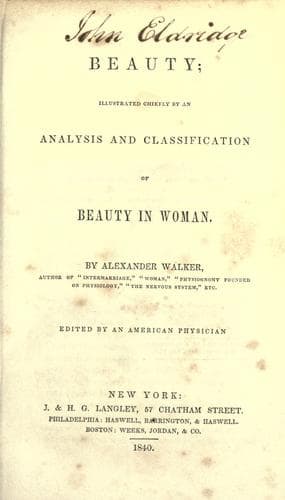
Beauty: Illustrated Chiefly by an Analysis and Classification of Beauty in WomanWalker, Alexander
Philosophy
Beauty: Illustrated Chiefly by an Analysis and Classification of Beauty in Woman
Walker, Alexander
Beauty, Personal; Women
"There is scarce a room, in any house whatever," says Hogarth, "where one
does not see the waving line employed in some way or other. How inelegant
would the shapes of all our moveables be without it? how very plain and
unornamental the mouldings of cornices and chimney-pieces, without the
variety introduced by the ogee member, which is entirely composed of
waving lines."
The distinctions I have here made, are farther illustrated by the remarks
of Alison, who says: "These ornaments being executed in a very hard and
durable substance, are in fact only beautiful when they appear but as
minute parts of the whole. The great constituent parts of every building
require direct and angular lines, because in such parts we require the
expression of stability and strength. It is only in the minute and
delicate parts of the work, that any kind of ornament is attempted with
propriety; and whenever ornaments exceed in size, in their quantity of
matter, or in the prominence of their relief, that proportion which, in
point of lightness or delicacy, we expect them to hold with respect to the
whole of the building, the imitation of the most beautiful vegetable forms
does not preserve them from the censure of clumsiness and deformity."
In dress, considered as an ornamental art, and, as practised by the sex
which chiefly studies it, the chief beauty depends on the adoption of
winding forms in drapery, and of wreaths of flowers for the head, &c.
These are essential to the variety and contrast, as well as to the gayety
which that sex desires.
"Uniformity," says Hogarth, "is chiefly complied with in dress, on account
of fitness, and seems to be extended not much farther than dressing both
arms alike, and having the shoes of the same color. For when any part of
dress has not the excuse of fitness or propriety for its uniformity of
parts, the ladies always call it formal."
These irregular, varying, and somewhat complicated draperies excite that
active curiosity, and those movements of imagination, to which skilful
women never neglect to address themselves in modern costume.
It is with the same feeling and intention, whether these be defined or
not, that, in the head-dress, they seek for bending lines and
circumvolutions, and that they combine variously the waves and the tresses
of the hair.
For the same reason, a feather or a flower is never placed precisely over
the middle of the forehead; and if two are employed, great care is taken
that their positions are dissimilar.
It has sometimes struck me as remarkable, that precious stones are almost
always arranged differently from flowers. While the latter are placed
irregularly, and in waving lines, not only on the head, but the bosom, and
the skirt of the dress, the former are in general regularly placed, either
on the median line of the person, as the middle of the forehead and, in
Eastern countries, of the nose, or symmetrically in similar pendants from
each ear, and bracelets on the arms and wrists.
Public-domain text, read in full here on John Shaqi.
Reviews
Reviews
No reviews yet
Be the first to share your thoughts on this work.
Elsewhere in the archive
Join the Discussion
Join the discussion
Sign in to leave a comment or review.
Sign InorCreate an account