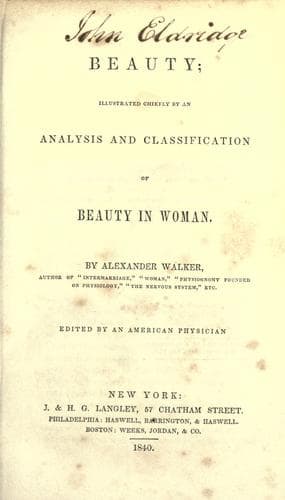
Beauty: Illustrated Chiefly by an Analysis and Classification of Beauty in WomanWalker, Alexander
Philosophy
Beauty: Illustrated Chiefly by an Analysis and Classification of Beauty in Woman
Walker, Alexander
Beauty, Personal; Women
The instinctive feeling which gives origin to this is, that flowers adorn
the system of life and reproduction, and by their color and smell,
associate with its emotions, which they also express and communicate to
others--they, therefore, assume the varied forms of that system; whereas,
diamonds, attached generally to mental organs, or organs of sense, are
significant of mental feelings, love of splendor, distinction, pride,
&c.--they, therefore, assume the symmetrical form of these organs. Hence,
too, flowers are recommended to the young; diamonds are permitted only to
the old.
_Beauty of Intellectual Objects._
I have already said, that the intellectual arts are, in their highest
efforts, characterized chiefly by animal forms, as in gesture, sculpture,
and painting, or by animal functions actually exercised, in oratory,
poetry, and music.
In the useful arts, the purpose is utility; in the ornamental arts, it is
bodily or sensual pleasure; and in the intellectual arts, it is the
pleasure of imagination.
The first elements of beauty, however, are not forgotten in these arts. As
simplicity is conspicuous in the works of nature, so is it a condition of
beauty in all the operations of mind. In philosophy, general theorems
become beautiful from this simplicity; and polished manners receive from
it dignity and grace. The intellectual arts are especially dependant upon
it: it has been a striking character of their most illustrious
cultivators, and of their very highest efforts.
How much the characters and accidents of elementary beauty influence
intellectual art, has been well shown by Mr. Knight.
"In the higher class of landscapes," he says, "whether in nature or in
art, the mere sensual gratification of the eye is comparatively so small,
as scarcely to be attended to: but yet, if there occur a single spot,
either in the scene or the picture, offensively harsh and glaring--if the
landscape-gardener, in the one, or the picture-cleaner, in the other, have
exerted their unhappy talents of polishing, all the magic instantly
vanishes, and the imagination avenges the injury offered to the sense. The
glaring and unharmonious spot, being the most prominent and obtrusive,
irresistibly attracts the attention, so as to interrupt the repose of the
whole, and leaves the mind no place to rest upon."
"It is, in some respects," he observes, "the same with the sense of
hearing. The mere sensual gratification, arising from the melody of an
actor's voice, is a very small part, indeed, of the pleasure which we
receive from the representation of a fine drama: but, nevertheless, if a
single note of the voice be absolutely cracked and out of tune, so as to
offend and disgust the ear, it will completely destroy the effect of the
most skilful acting, and render all the sublimity and pathos of the finest
tragedy ludicrous."
Public-domain text, read in full here on John Shaqi.
Reviews
Reviews
No reviews yet
Be the first to share your thoughts on this work.
Elsewhere in the archive
Join the Discussion
Join the discussion
Sign in to leave a comment or review.
Sign InorCreate an account