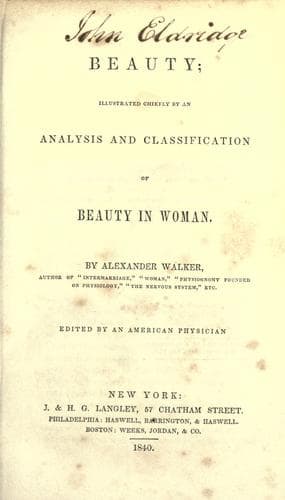
Beauty: Illustrated Chiefly by an Analysis and Classification of Beauty in WomanWalker, Alexander
Philosophy
Beauty: Illustrated Chiefly by an Analysis and Classification of Beauty in Woman
Walker, Alexander
Beauty, Personal; Women
This, I may observe, is a concession of much that he elsewhere
inconsistently contends for; for sensual beauty could never act thus
powerfully, if it possessed not fundamental importance as an element even
in the most complex beauty.
That the second kind of beauty also enters into the acts or products of
intellectual beauty, is sufficiently illustrated by the observation of
Hogarth, who on this subject observes, that all the common and necessary
motions for the business of life are performed by men in straight or plain
lines, while all the graceful and ornamental movements are made in waving
lines.
As Alison has given the best view of the history and character of beauty
in the intellectual arts, as that indeed constitutes the most valuable
portion of his work, I shall conclude this section by a greatly abridged
view of these as nearly as possible in his own words.
There is no production of taste, which has not many qualities of a very
indifferent kind; and our sense of the beauty or sublimity of every object
accordingly depends upon the quality or qualities of it which we consider.
This, Mr. Alison might have observed, is in great measure dependant upon
our will. We can generally, when we please, confine our consideration of
it to the qualities that least excite pleasurable or painful emotion, and
that can least interest the imagination.
It is in consequence of this, that the exercise of criticism always
destroys, for the time, our sensibility to the beauty of every
composition, and that habits of this kind generally destroy the
sensibility of taste.
When, on the other hand, the emotions of sublimity or beauty are produced,
it will be found that some affection is uniformly first excited by the
presence of the object; and whether the general impression we receive is
that of gayety, or tenderness, or melancholy, or solemnity, or terror,
&c., we have never any difficulty of determining.
But whatever may be the nature of that simple emotion which any object is
fitted to excite, if it produce not a train of kindred thought in our
minds, we are conscious only of that simple emotion.
In many cases, on the contrary, we are conscious of a train of thought
being immediately awakened in the imagination, analogous to the character
of expression of the original object.
Public-domain text, read in full here on John Shaqi.
Reviews
Reviews
No reviews yet
Be the first to share your thoughts on this work.
Elsewhere in the archive
Join the Discussion
Join the discussion
Sign in to leave a comment or review.
Sign InorCreate an account