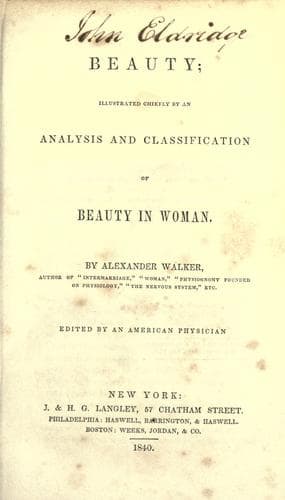
Beauty: Illustrated Chiefly by an Analysis and Classification of Beauty in WomanWalker, Alexander
Philosophy
Beauty: Illustrated Chiefly by an Analysis and Classification of Beauty in Woman
Walker, Alexander
Beauty, Personal; Women
"Thus, when we feel either the beauty or sublimity of natural scenery--the
gay lustre of a morning in spring, or the mild radiance of a
summer-evening--the savage majesty of a wintry storm, or the wild
magnificence of the tempestuous ocean--we are conscious of a variety of
images in our minds, very different from those which the objects
themselves present to the eye. Trains of pleasing or of solemn thought
arise spontaneously within our minds; our hearts swell with emotions, of
which the objects before us seem to afford no adequate cause; and we are
never so much satiated with delight, as when, in recalling our attention,
we are unable (little able, perhaps, and less disposed) to trace either
the progress or the connexion of those thoughts, which have passed with so
much rapidity through our imagination.
"The effect of the different arts of taste is similar. The landscapes of
Claude Lorraine, the poetry of Milton, the music of the greatest masters,
excite feeble emotions in our minds when our attention is confined to the
qualities they present to our senses, or when it is to such qualities of
their composition that we turn our regard. It is then only we feel the
sublimity or beauty of their productions, when our imaginations are
kindled by their power, when we lose ourselves amid the number of images
that pass before our minds, and when we waken at last from this play of
fancy, as from the charm of a romantic dream.
"The degree in which the emotions of sublimity or beauty are felt, is in
general proportioned to the prevalence of those relations of thought in
the mind, upon which this exercise of imagination depends. The principal
relation which seems to take place in those trains of thought that are
produced by objects of taste, is that of resemblance; the relation, of all
others the most loose and general, and which affords the greatest range of
thought for our imagination to pursue. Wherever, accordingly, these
emotions are felt, it will be found, not only that this is the relation
which principally prevails among our ideas, but that the emotion itself is
proportioned to the degree in which it prevails.
Public-domain text, read in full here on John Shaqi.
Reviews
Reviews
No reviews yet
Be the first to share your thoughts on this work.
Elsewhere in the archive
Join the Discussion
Join the discussion
Sign in to leave a comment or review.
Sign InorCreate an account