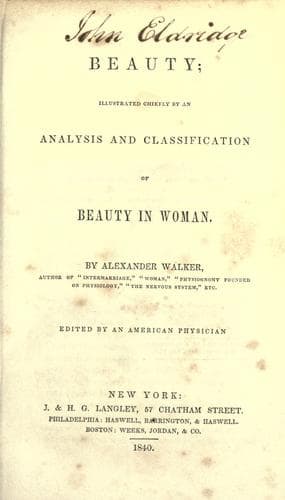
Beauty: Illustrated Chiefly by an Analysis and Classification of Beauty in WomanWalker, Alexander
Philosophy
Beauty: Illustrated Chiefly by an Analysis and Classification of Beauty in Woman
Walker, Alexander
Beauty, Personal; Women
"To examine this point concerning the effect of tragedy in a proper
manner," says that writer, "we must previously consider how we are
affected by the feelings of our fellow-creatures in circumstances of real
distress. I am convinced we have a degree of delight, and that no small
one, in the real misfortunes and pains of others; for, let the affection
be what it will in appearance, if it does not make us shun such objects,
if on the contrary it induces us to approach them, if it makes us dwell
upon them, in this case I conceive we must have a delight or pleasure of
some species or other in contemplating objects of this kind.... Our
delight in cases of this kind is very greatly heightened, if the sufferer
be some excellent person who sinks under an unworthy fortune.... The
delight we have in such things hinders us from shunning scenes of misery;
and the pains we feel, prompt us to relieve ourselves, in relieving those
who suffer.... In imitated distress, the only difference is the pleasure
resulting from the effects of imitation."
A more monstrous doctrine than this was never perhaps enunciated. A very
little analysis will expose its fallacy.
In relation to events of this kind, there are three very distinct
cases--real occurrence, subsequent inspection or historical narration, and
dramatic representation; in each, the affection of the mind is very
different; and nearly all the errors on this subject seem to have occurred
from confounding them. Burke has done this in the greatest degree.
The real occurrence of unmerited suffering is beheld with no delight, but
with unmixed pain, by every well-constituted mind. Hume,[22] therefore,
justly observes, that "the same object of distress, which pleases in a
tragedy, were it really set before us, would give the most unfeigned
uneasiness." It is only by confounding this with the next case, of
subsequent inspection or historical narration, that Burke gets into error
here.
"We do not," says Burke, "sufficiently distinguish what we would by no
means choose to do [or _to see done_--he should have added] from what we
should be eager enough to see if it was once done. We delight in seeing
things [_after they are done_--he should have added], which, so far from
doing, our heartiest wishes would be to see redressed."
That the additions I have made, more truly state the case, seems as
evident, as it is, that they afford a very different conclusion from
Burke's, of our beholding unmerited suffering with delight. But he himself
proves this by the very instance which he gives in illustration of his
doctrine.
Public-domain text, read in full here on John Shaqi.
Reviews
Reviews
No reviews yet
Be the first to share your thoughts on this work.
Elsewhere in the archive
Join the Discussion
Join the discussion
Sign in to leave a comment or review.
Sign InorCreate an account