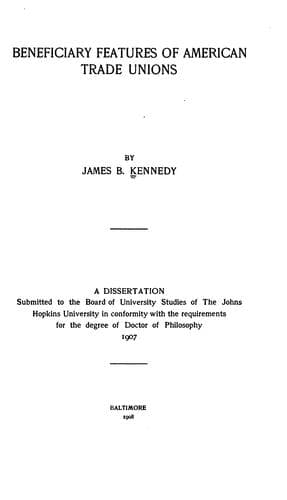
Beneficiary Features of American Trade UnionsKennedy, James Boyd
History
Beneficiary Features of American Trade Unions
Kennedy, James Boyd
Fraternal insurance -- United States; Labor unions -- United States
The Brotherhood of Locomotive Engineers is not only the oldest of the
railway unions, but was the first to institute national beneficiary
features. Three years after its organization, in September, 1866, the
grand division levied an assessment to raise a fund for "widows and
orphans and totally disabled members." The law was unsatisfactory, and
few subordinate divisions paid the assessments prior to the Cincinnati
convention of October, 1867. This convention ordered all assessments
paid at once, and on December 2, 1867, $1212.40 was paid over to the
chairman of the board of trustees. This was the nucleus of a fund which
reached $10,787.63 on March 1, 1871. On account of charges of
mismanagement and the slow growth of the fund repeated efforts were made
to repeal the "fund" law, but without success. At the Nashville
convention of 1870 a committee appointed to consider the disposition of
the fund at the expiration of the five years recommended that the entire
sum be paid back to the subordinate divisions. The grand chief opposed
this use of the fund, since he regarded it as the Brotherhood's
"strongest pillar."[12]
[Footnote 12: _Ibid.,_ Vol. 5, p. 294.]
Before the expiration of the five-year period, however, on December 3,
1867, the Brotherhood founded an insurance association.[13] On March 13,
1869, the secretary-treasurer reported: number of members admitted
during 1868, 2426; amount of claims paid, $31,920; average amount of
each claim, $1520.09; cost per member, $19. At Baltimore, on October
21,1869, by-laws were adopted providing for assessments of $1 per member
for each death, and 50 cents for each case of total disability,[14] and
at the annual convention of 1871 President Sherman reported that for the
three and one half years of the life of the association there had been
86 deaths and 88 assessments, aggregating $196,358.50, an average of
$3278.
[Footnote 13: _Ibid.,_ Vol. 3, p. 232.]
[Footnote 14: Locomotive Engineers' Journal, Vol. 4, p. 31.]
The industrial depression of the seventies decreased the membership, but
with the revival of trade an increase set in. Since January 1, 1890,
insurance has been compulsory upon all members of the Brotherhood under
fifty years of age. In January, 1890, the association numbered about
8000, and on January 1, 1897, it had increased to 18,000. During the
twenty-five years of voluntary insurance $3,122,-669.61 was paid in
death and disability benefits, and at the close of 1896 this total had
been increased to $5,771,214.61.[15] Ten years later, December 31, 1906,
the membership had grown to 49,328, with $97,799,500 insurance in force,
and the total aggregate paid in death and disability claims had reached
$10,323,181.60.
[Footnote 15: _Ibid.,_ Vol. 25, p. 951; Vol. 31, p. 504.]
Public-domain text, read in full here on John Shaqi.
Reviews
Reviews
No reviews yet
Be the first to share your thoughts on this work.
Join the Discussion
Join the discussion
Sign in to leave a comment or review.
Sign InorCreate an account