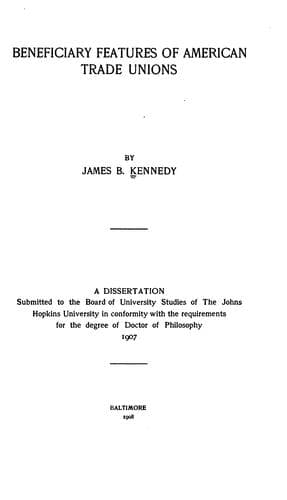
Beneficiary Features of American Trade Unions — John Shaqi
Beneficiary Features of American Trade UnionsKennedy, James Boyd
History
Beneficiary Features of American Trade Unions
Kennedy, James Boyd
Fraternal insurance -- United States; Labor unions -- United States
The next organization of railway employees to be formed was the
"Conductors' Brotherhood," at Mendota, Illinois, July 6, 1868. Being
desirous of a more comprehensive organization, a few conductors issued,
in November, 1868, a circular to the railway conductors of the United
States and the British Provinces. As a result of this effort, the Grand
Division of the Order of Railway Conductors was organized at Columbus,
Ohio, on December 15, 1868.[16] For a period of twenty-two years the
organization grew slowly against much opposition. From 1877 to 1890 the
Order was exclusively beneficiary, and many of its members withdrew to
organize the "Grand International Brotherhood of Railway Conductors of
America." In 1890 the National Convention decided to make collective
bargaining one of its functions, and the members of the International
Brotherhood joined the Order of Railway Conductors in such numbers that
a year later the Brotherhood disbanded. On January 1, 1890, there were
249 subordinate divisions and 13,720 members; on January 1, 1904, there
were 446 divisions with 31,288 members.
[Footnote 16: Proceedings, 1868-1885 (Cedar Rapids, 1888), p. 13.]
The convention which founded the Grand Division of the Order of Railway
Conductors also instituted a mutual insurance association. The
association thus formed was a voluntary society. Members paid $1 upon
each death or each case of disability and the amount thus collected
constituted the "benefit" paid.[17] At the first annual session held in
Chicago in June, 1869, efforts were made to create a permanent insurance
fund, but without result; and at the second session held in Buffalo, New
York, in October, 1869, after lengthy discussion, the benefit law,
adopted in 1868, was unanimously repealed.[18] For a year the Order had
no insurance feature; but at the third session in October, 1870, a
definite plan was adopted.[19]
[Footnote 17: Proceedings, 1868-1885 (Cedar Rapids, 1888), p. 19.]
[Footnote 18: _Ibid.,_ p. 42.]
[Footnote 19: _Ibid.,_ pp. 48-49.]
Public-domain text, read in full here on John Shaqi.
Reviews
Reviews
No reviews yet
Be the first to share your thoughts on this work.
Join the Discussion
Join the discussion
Sign in to leave a comment or review.
Sign InorCreate an account