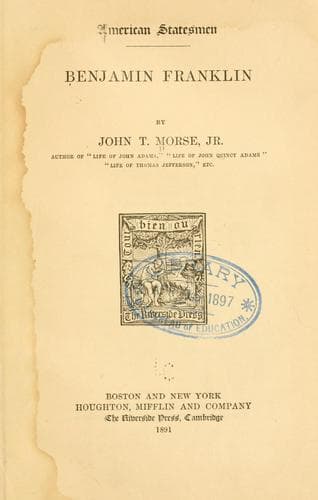
Benjamin FranklinMorse, John T., Jr. (John Torrey)
History
Benjamin Franklin
Morse, John T., Jr. (John Torrey)
Franklin, Benjamin, 1706-1790
husband "had left many debts, which his successor might be call'd upon
to pay." Few men, even if warmly enamored, would have entered into the
matrimonial contract under circumstances so discouraging; and there are
no indications save the marriage itself that Franklin was deeply in
love. Yet on September 1, 1730, the pair were wedded. Mrs. Franklin
survived for forty years thereafter, and neither seems ever to have
regretted the step. "None of the inconveniences happened that we had
apprehended," wrote Franklin; "she proved a good and faithful helpmate;
assisted me much by attending the shop; we throve together, and have
ever mutually endeavored to make each other happy." A sensible,
comfortable, satisfactory union it was, showing how much better is sense
than sensibility as an ingredient in matrimony. Mrs. Franklin was a
handsome woman, of comely figure, yet nevertheless an industrious and
frugal one; later on in life Franklin boasted that he had "been clothed
from head to foot in linen of [his] wife's manufacture." An early
contribution of his own to the domestic _menage_ was his illegitimate
son, William, born soon after his wedding, of a mother of whom no record
or tradition remains. It was an unconventional wedding gift to bring
home to a bride; but Mrs. Franklin, with a breadth and liberality of
mind akin to her husband's, readily took the babe not only to her home
but really to her heart, and reared him as if he had been her own
offspring. Mr. Parton thinks that Franklin gave this excellent wife no
further cause for suspicion or jealousy.
CHAPTER II
A CITIZEN OF PHILADELPHIA: CONCERNMENT IN PUBLIC AFFAIRS
So has ended the first stage, in the benign presence of Hymen. The
period of youth may be regarded as over; but the narrative thereof,
briefly as it has been given, is not satisfactory. One longs to help out
the outline with color, to get the expression as well as merely the
features of the young man who is going to become one of the greatest men
of the nation. Many a writer and speaker has done what he could in this
task, for Franklin has been for a century a chief idol of the American
people. The Boston boy, the boy printer, the runaway apprentice, the
young journeyman, friendless and penniless in distant London, are
pictures which have been made familiar to many generations of
schoolboys; and the trifling anecdote of the bread rolls eaten in the
streets of Philadelphia has for its only rival among American historical
traditions the more doubtful story about George Washington, the
cherry-tree, and the little hatchet.
Public-domain text, read in full here on John Shaqi.
Reviews
Reviews
No reviews yet
Be the first to share your thoughts on this work.
Join the Discussion
Join the discussion
Sign in to leave a comment or review.
Sign InorCreate an account