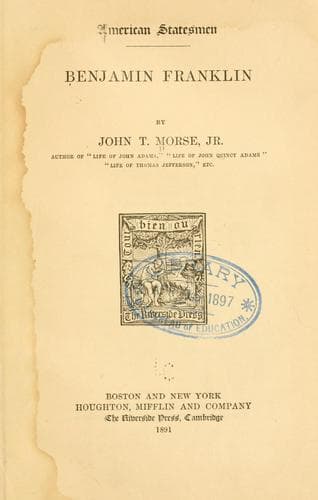
Benjamin FranklinMorse, John T., Jr. (John Torrey)
History
Benjamin Franklin
Morse, John T., Jr. (John Torrey)
Franklin, Benjamin, 1706-1790
Yet, if plain truth is to be told, there was nothing unusual about this
sunrise, no rare tints of divine augury; the luminary came up in
every-day fashion. Franklin had done much reading; he had taken pains to
cultivate a good style in writing English; he had practiced himself in
dispute; he had adopted some odd notions, for example vegetarianism in
diet; he had at times acquired some influence among his fellow
journeymen, and had used it for good; he had occasionally fallen into
the society of men of good social position; he had kept clear of the
prevalent habit of excessive drinking; sometimes he had lived frugally
and had laid up a little money; more often he had been wasteful; he had
been very dissolute, and in sowing his wild oats he had gone down into
the mud. His autobiography gives us a simple, vivid, strong picture,
which we accept as correct, though in reading it one sees that the lapse
of time since the occurrences narrated, together with his own success
and distinction in life, have not been without their obvious effect. By
the time he thought it worth while to write those pages, Franklin had
been taught to think very well of himself and his career. For this
reason he was, upon the one hand, somewhat indifferent as to setting
down what smaller men would conceal, confident that his fame would not
stagger beneath the burden of youthful wrong-doing; on the other hand,
he deals rather gently, a little ideally, with himself, as old men are
wont to acknowledge with condemnation tempered with mild forgiveness the
foibles of their early days. It is evident that, as a young man,
Franklin intermingled sense with folly, correct living with dissipation,
in a manner that must have made it difficult for an observer to forecast
the final outcome, and which makes it almost equally impossible now to
form a satisfactory idea of him. He is not to be disposed of by placing
him in any ready-made and familiar class. If he had turned out a bad
man, there would have been abundance in his early life to point the
moralist's warning tale; as he turned out a very reputable one, there is
scarcely less abundance for panegyrists to expatiate upon. Certainly he
was a man to attract some attention and to carry some weight, yet not
more than many another of whom the world never hears. At the time of his
marriage, however, he is upon the verge of development; a new period of
his life is about to begin; what had been dangerous and evil in his ways
disappears; the breadth, originality, and practical character of his
mind are about to show themselves. He has settled to a steady
occupation; he is industrious and thrifty; he has gathered much
information, and may be regarded as a well-educated man; he writes a
plain, forcible style; he has enterprise and shrewdness in matters of
business, and good sense in all matters,--that is the chief point, his
sound sense has got its full growth and vigor, and of sound sense no man
ever had more.
Public-domain text, read in full here on John Shaqi.
Reviews
Reviews
No reviews yet
Be the first to share your thoughts on this work.
Join the Discussion
Join the discussion
Sign in to leave a comment or review.
Sign InorCreate an account