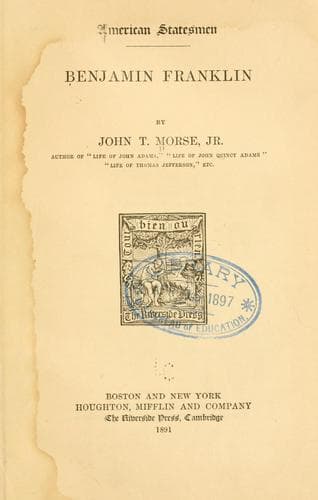
Benjamin FranklinMorse, John T., Jr. (John Torrey)
History
Benjamin Franklin
Morse, John T., Jr. (John Torrey)
Franklin, Benjamin, 1706-1790
Very soon he not only prospers financially, but begins to
secure at first that attention and soon afterward that influence which
always follow close upon success in practical affairs. He becomes the
public-spirited citizen; scheme after scheme of social and public
improvement is suggested and carried forward by him, until he justly
comes to be one of the foremost citizens of Philadelphia. The
enumeration of what he did within a few years in this small new town and
poor community will be found surprising and admirable.
His first enterprise, of a quasi public nature, was the establishment of
a library. There were to be fifty subscribers for fifty years, each
paying an entrance fee of forty shillings and an annual due of ten
shillings. He succeeded only with difficulty and delay, yet he did
succeed, and the results were important. Later a charter was obtained,
and the number of subscribers was doubled. "This," he says, "was the
mother of all the North American subscription libraries, now so
numerous.... These libraries have improved the general conversation of
the Americans, made the common traders and farmers as intelligent as
most gentlemen from other countries, and perhaps have contributed in
some degree to the stand so generally made throughout the colonies in
defense of their privileges." "Reading became fashionable," he adds. But
it was not difficult to cultivate the desire for reading; that lay close
to the surface. The boon which Franklin conferred lay rather in setting
the example of a scheme by which books could be cheaply obtained in
satisfactory abundance.
From the course of this business he drew one of those shrewd, practical
conclusions which aided him so much in life. He says that he soon felt
"the impropriety of presenting one's self as the proposer of any useful
project that might be supposed to raise one's reputation in the smallest
degree above that of one's neighbors, when one has need of their
assistance to accomplish that project. I therefore put myself as much as
I could out of sight, and stated it as a scheme of a _number of
friends_, who had requested me to go about and propose it." This method
he found so well suited to the production of results that he habitually
followed it in his subsequent undertakings. It was sound policy; the
self-abnegation helped success; the success secured personal prestige.
It was soon observed that when "a number of friends" or "a few
gentlemen" were represented by Franklin, their purpose was usually good
and was pretty sure to be carried through. Hence came reputation and
influence.
Public-domain text, read in full here on John Shaqi.
Reviews
Reviews
No reviews yet
Be the first to share your thoughts on this work.
Join the Discussion
Join the discussion
Sign in to leave a comment or review.
Sign InorCreate an account