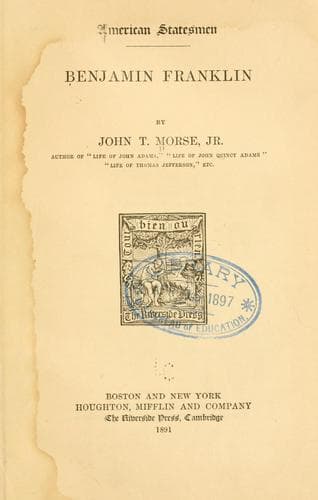
Benjamin FranklinMorse, John T., Jr. (John Torrey)
History
Benjamin Franklin
Morse, John T., Jr. (John Torrey)
Franklin, Benjamin, 1706-1790
Moreover, the first event of public importance after Governor Penn's
advent had, in its early stage, the effect of drawing him very closely
to Franklin. Some of the settlers on the frontier, infuriated beyond the
control of reason by the Indian marauding parties, gathered together for
the purpose of slaughter. If they had directed their vengeance against
the braves, and even all the occupants of the villages of the
wilderness, they might have been excused though their vindictive rage
led them to retaliate by the same barbarities which the red men had
practiced towards the whites. Unfortunately, instead of courageously
turning their faces towards the forests, they turned their backs in that
direction, where only there was any enemy to be feared, and in a safe
expedition they wreaked a deadly, senseless, cowardly, and brutal
vengeance on an unoffending group of twenty old men, women, and
children, living peacefully and harmlessly near Lancaster. The infamous
story is familiar in the annals of Pennsylvania as the "Paxton
massacre," because the "Paxton boys," the perpetrators, came from the
Scotch-Irish settlement bearing that name.
Franklin's indignation was great, and he expressed it forcibly in a
pamphlet. But many, even of the class which should have felt with him,
were in such a temper that they would condemn no act done against an
Indian. Encouraged by the prevalence of this feeling, this same band,
swelled to a numerous and really formidable force, had the audacity to
start for Philadelphia itself, with the avowed purpose of massacring
there a small body of civilized Christian Indians, who had fled thither
for safety under the charge of their Moravian missionary, and against
whom not a complaint could be made. Panic reigned in the City of
Brotherly Love, little competent to cope with imminent violence. In the
crisis citizens and governor could conceive no more hopeful scheme than
an appeal to Franklin, which was made at once and urgently. The governor
himself actually took up his residence in Franklin's house, and stayed
there till the threat of trouble passed over, speaking, writing, and
ordering only at Franklin's dictation,--a course which had in it more of
sense than of dignity. The appeal was made in the right quarter. Already
profoundly moved in this matter, Franklin was prompt and zealous to save
his city from a shameful act, and the Indians from barbarous murder. His
efforts soon gathered, and after a fashion organized, a body of
defenders probably somewhat more numerous than the approaching mob. Yet
a collision would have been most unfortunate, whatever the result; and
to avert it Franklin took it upon him to go in person to meet the
assailants. His courage, coolness, and address prevailed; he succeeded
in satisfying the "Paxton boys" that they were so greatly outnumbered
that, far from attacking others, they could only secure their own safety
by instant dispersion. Thus by the resources and presence of mind of one
Public-domain text, read in full here on John Shaqi.
Reviews
Reviews
No reviews yet
Be the first to share your thoughts on this work.
Join the Discussion
Join the discussion
Sign in to leave a comment or review.
Sign InorCreate an account