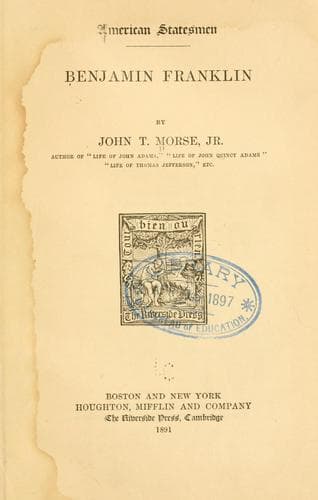
Benjamin FranklinMorse, John T., Jr. (John Torrey)
History
Benjamin Franklin
Morse, John T., Jr. (John Torrey)
Franklin, Benjamin, 1706-1790
man Philadelphia was saved from a day of which the bloody stain could
never have been effaced from her good fame.
But Franklin seemed for a while to reap more of hostility than of
gratitude for his gallant and honorable conduct in this emergency.
Governor Penn was an ignoble man, and after the danger was over he left
the house, in which he had certainly played a rather ignominious part,
with those feelings toward his host which a small soul inevitably
cherishes toward a greater under such circumstances. Moreover, there
were very many among the people who had more of sympathy with the
"Paxton boys" than with the wise and humane man who had thwarted them.
"For about forty-eight hours," Franklin wrote to one of his friends, "I
was a very great man;" but after "the fighting face we put on" caused
the insurgents to turn back, "I became a less man than ever; for I had,
by this transaction, made myself many enemies among the populace," a
fact of which the governor speedily took advantage. But without this
episode enmity between Penn and Franklin was inevitable. They served
masters whose ends were wide apart; upon the one side avaricious
proprietaries of little foresight and judgment, upon the other side a
people jealous of their rights and unwilling to leave to any one else
the definition and interpretation of them.
Soon it became known that the instructions of the new governor differed
in no substantial particular from those of his predecessors. The
procession of vetoes upon the acts of the Assembly resumed its familiar
and hateful march. A militia bill was thus cut off, because, instead of
leaving with the governor the nomination of regimental officers, it
stipulated that the rank and file should name three persons for each
position, and that the governor should choose one of these,--an
arrangement bad in itself, but perhaps well suited to the habits and
even the needs of the province at that time. A tax bill met the like
fate, because it did not discriminate in favor of the located lands of
the proprietaries by rating their best lands at no higher valuation than
the worst lands of other persons. Soon it was generally felt that
matters were as bad as ever, and with scantier chances of improvement.
Then "all the old wounds broke out and bled afresh; all the old
grievances, still unredressed, were recollected; despair succeeded of
seeing any peace with a family that could make such returns to all
overtures of kindness." The aggrieved party revived its scheme for a
transfer of the government from the proprietaries to the crown, and
Franklin threw himself into the discussion with more of zeal and ardor
than he had often shown.
Public-domain text, read in full here on John Shaqi.
Reviews
Reviews
No reviews yet
Be the first to share your thoughts on this work.
Join the Discussion
Join the discussion
Sign in to leave a comment or review.
Sign InorCreate an account