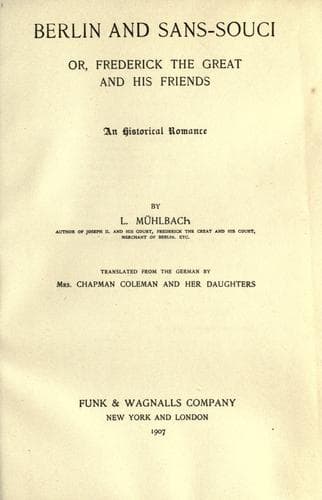
Berlin and Sans-Souci; Or, Frederick the Great and His FriendsMühlbach, L. (Luise)
History
Berlin and Sans-Souci; Or, Frederick the Great and His Friends
Mühlbach, L. (Luise)
Frederick II, King of Prussia, 1712-1786 -- Fiction; Prussia (Germany) -- History -- Frederick II, 1740-1786 -- Fiction
Frederick was gay and talkative. He told them that the Signora
Barbarina had arrived, and would appear that evening at the castle
theatre. He invited his mother and the two princesses to be present.
He requested them to make tasteful and becoming toilets, and to be
bright and amiable at the ball and supper after the theatre. The
king implored them both to be gay: the one, in order to show that
she was neither angry nor jealous; the other, that she was proud and
happy.
The curiosity of the two young girls was much excited, and they
urged the king to explain his mysterious words. He informed them
that Count Tessin, the Swedish ambassador, would be present at the
ball; that he was sent to Berlin to select a wife for the prince
royal of Sweden, or, rather, to receive one; the choice, it
appeared, had been already made, as the count had asked the king if
he might make proposals for the hand of the Princess Amelia, or if
she were already promised in marriage. The king replied that Amelia
was bound by no contract, and that proposals from Sweden would be
graciously received.
"Be, therefore, lovely and attractive," said the king, placing his
hand caressingly upon the rosy cheek of his little sister; "prove to
the count that the intellectual brow of my sweet sister is fitted to
wear a crown worthily."
The queen-mother glanced toward the window into which the Princess
Ulrica had hastily withdrawn.
"And will your majesty really consent that the youngest of my
daughters shall be first married?"
The king followed the glance of his mother, and saw the frowning
brow and trembling lip of his sister. Frederick feared to increase
the mortification of Ulrica, and seemed, therefore, not to observe
her withdrawal.
"I think," said he, "your majesty was not older than Amelia when you
married my father; and if the crown prince of Sweden wishes to marry
Amelia, I see no reason why we should refuse him. Happily, we are
not Jews, and our laws do not forbid the younger sister to marry
first. To refuse the prince the hand of Amelia, or to offer him the
hand of Ulrica, would indicate that we feared the latter might
remain unsought. I think my lovely and talented sister does not
deserve to be placed in such a mortifying position, and that her
hand will be eagerly sought by other royal wooers."
"And, for myself, I am not at all anxious to marry," said Ulrica,
throwing her head back proudly, and casting a half-contemptuous,
half-pitiful look at Amelia. "I have no wish to marry. Truly, I have
not seen many happy examples of wedded life in our family. All my
sisters are unhappy, and I see no reason why I should tread the same
thorny path."
Public-domain text, read in full here on John Shaqi.
Reviews
Reviews
No reviews yet
Be the first to share your thoughts on this work.
Join the Discussion
Join the discussion
Sign in to leave a comment or review.
Sign InorCreate an account