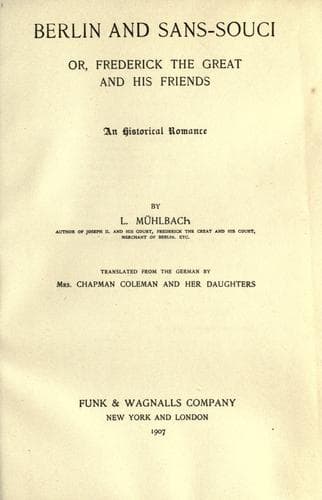
Berlin and Sans-Souci; Or, Frederick the Great and His FriendsMühlbach, L. (Luise)
History
Berlin and Sans-Souci; Or, Frederick the Great and His Friends
Mühlbach, L. (Luise)
Frederick II, King of Prussia, 1712-1786 -- Fiction; Prussia (Germany) -- History -- Frederick II, 1740-1786 -- Fiction
The king smiled. "I see the little Ulrica shares my aversion to
wedded life, but we cannot expect, dearest, that all the world
should be equally wise. We will, therefore, allow our foolish sister
Amelia to wed, and run away from us. This marriage will cost her
anxiety and sorrow; she must not only place her little feet in the
land of reindeers, bears, and eternal snows, but she must also be
baptized and adopt a new religion. Let us thank God, then, that the
prince has had the caprice to pass you by and choose Amelia, who, I
can see, is resolved to be married. We will, therefore, leave the
foolish child to her fate."
It was Frederick's intention, by these light jests, to comfort his
sister Ulrica, and give her time to collect herself. He did not
remark that his words had a most painful effect upon his younger
sister, and that she became deadly pale as he said she must change
her faith in order to become princess royal of Sweden.
The proud queen-mother had also received this announcement angrily.
"I think, sire," said she, "that the daughter of William the Second,
and the sister of the King of Prussia, might be allowed to remain
true to the faith of her fathers."
"Madame," said the king, bowing reverentially, "the question is not,
I am sorry to say, as to Amelia's father or brother; she will be the
mother of sons, who, according to the law of the land, must be
brought up in the religion of their father. You see, then, that if
this marriage takes place, one of the two contracting parties must
yield; and, it appears to me, that is the calling and the duty of
the woman."
"Oh, yes," said the queen bitterly, "you have been educated in too
good a school, and are too thoroughly a Hohenzollern, not to believe
in the complete self-renunciation of women. At this court, women
have only to obey."
"Nevertheless, the women do rule over us; and even when we appear to
command, we are submissive and obedient," said the king, as he
kissed his mother's hand and withdrew.
The three ladies also retired to their own rooms immediately. Each
one was too much occupied with her own thoughts to bear the presence
of another.
And now, being alone, the Princess Ulrica found it no longer
necessary to retain the smiles which she had so long and with such
mighty effort forced to play upon her lips; every pulse was beating
with glowing rage, and she gave free course to her scorn.
Her younger sister, this little maiden of eighteen years, was to be
married, to wed a future king; while she, the eldest, now two-and-
twenty, remained unchosen! And it was not her own disinclination nor
the will of the king which led to this shameful result; no! the
Swedish ambassador came not to seek her hand, but that of her
sister! She, the elder, was scorned--set aside. The king might
truthfully say there was no law of the land which forbade the
marriage of the younger sister before the elder; but there was a law
of custom and of propriety, and this law was trampled upon.
Public-domain text, read in full here on John Shaqi.
Reviews
Reviews
No reviews yet
Be the first to share your thoughts on this work.
Join the Discussion
Join the discussion
Sign in to leave a comment or review.
Sign InorCreate an account