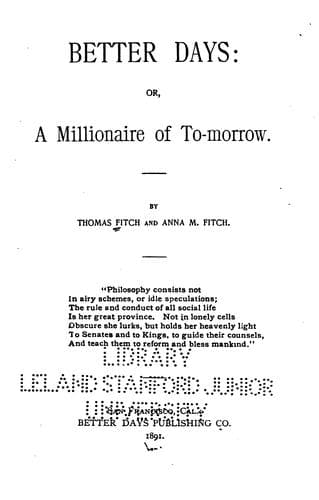
Better days; or, A Millionaire of To-morrowFitch, Thomas
Philosophy
Better days; or, A Millionaire of To-morrow
Fitch, Thomas
Utopias -- Fiction; West (U.S.) -- Fiction
“It is an innovation certainly, doctor, but just such a one as might
have been expected in Chicago. The people of this city have not yet
passed the _noblesse oblige_ period. You know that in all large cities
there is liable to come a time when the citizens divide into separate
communities, usually with separate interests, and without any general
public spirit. In New York, for instance, Madison Square takes no pride
in the East River bridge, Avenue A does not care whether the Grant
monument shall ever be completed, and the Statue of Liberty on Bedloe’s
Island is as strange to many a resident of Harlem as if she were planted
on the banks of the Neva. But the people of Chicago, though locally
divided into Northsiders, and Southsiders, and Westsiders, are joined in
interest for Chicago against the world. Any project that promises glory
or profit for the Lake City will cause her citizens to open their pocket
books. These Illinois Don Quixotes never tire of sounding the praises of
their Dulcinea, and are ever ready to break a lance in her honor.”
“Is not this race,” said Dr. Eustace, “under the auspices of the
National Exposition?”
“Not at all,” replied the professor. “As I am informed, a party of
speculators leased a thousand acres of land here, ten miles from the
city limits. They have, as you see, inclosed it and provided it with the
usual buildings, including seats for one hundred thousand spectators.
The race course is circular in form, four miles in length, and seven
railroad tracks are laid around it. The officers of the leading railroad
corporations of the country readily consented to send locomotives and
engineers here to compete for the prizes offered, and—you witness the
result. This is the third day of the races, and still the interest seems
undiminished.”
It was late in the month of July, 1892, and although the World’s
Exposition was not yet formally opened, tens of thousands of strangers
thronged the hotels of Chicago and added to the gayety of her streets.
The great attraction of the day was the locomotive railroad race, and
about twenty acres of people, representing all nations, filled the
benches and spread over the outer circle of the great four-mile track.
Seven of the largest locomotives in America, selected or constructed for
this race, were steaming up and down the tracks, waiting for the signal
to range themselves under a white cable, which was stretched diagonally
across the race course at such an angle as to equalize the difference of
length of inner and outer tracks. Each locomotive was draped with its
distinguishing colors, worn also by its attendant engineer and fireman.
The favorite engine in the pool rooms was the Chauncey M. Depew, entered
by the New York Central Railroad Company.
The furnishings of this engine were of polished silver, with draperies
of blue silk, and the engineer and fireman wore shirts and caps of the
same color.
Public-domain text, read in full here on John Shaqi.
Reviews
Reviews
No reviews yet
Be the first to share your thoughts on this work.
Join the Discussion
Join the discussion
Sign in to leave a comment or review.
Sign InorCreate an account