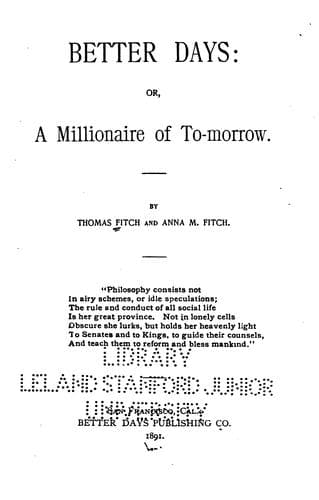
Better days; or, A Millionaire of To-morrowFitch, Thomas
Philosophy
Better days; or, A Millionaire of To-morrow
Fitch, Thomas
Utopias -- Fiction; West (U.S.) -- Fiction
The engine which most attracted the admiration of the throng was the
Collis P. Huntington, entered by the Southern Pacific Company. All the
furnishings as well as the wheels of this locomotive were gilded and
burnished for the occasion. The attendants wore shirts and caps of
crimson, and the drapery consisted of ropes of crimson roses, the
freshness of which, while coiled around smoke stack and boiler, was
accounted for by the fact that they were cut from asbestos cloth made
and tinted for the purpose.
The directors of the railroad corporations centering in Chicago had
readily extended aid and co-operation to the company organized in that
city for the construction and conduct of a locomotive race track, for it
was conceded that no more instructive school for engineers and firemen
could have been devised, and that there was no better field in which to
make experiments in machinery, tests of fuel consumption, and economical
creation and application of dynamic force. Almost every railroad company
in the United States and Canada entered one or more locomotives for the
races, which were advertised for the last week of July, 1892, and,
notwithstanding the large sums offered for premiums, and the great
expense of building and maintaining the race course, the enterprise
proved exceedingly profitable to its projectors.
Among the one hundred and fifty thousand spectators of the contest was
Professor John Thornton, of Boston, who, ten years before, had been the
hardworking principal of the Denver public schools, but who, through the
death of an uncle, inherited a fortune of five millions of dollars, and
was now one of the solid men and social magnates of the Hub.
During the years of poverty and struggle which antedated Professor
Thornton’s introduction to the ranks of wealth, he had grown to regard
very rich men with aversion and contempt. He was fond of quoting the
aphorism that the Lord expressed his opinion of money by the kind of men
he bestowed it upon, and he was stout in the belief that any man who, in
this world of human misery, could make and keep five millions of
dollars, was too selfish, if not too dishonest, for an associate. He did
not carry his opinions so far as to refuse the estate which fell to him,
but he was exceedingly generous with his income, and he never ceased to
criticise the millionaires.
Professor Thornton was generally regarded by his friends as a Crœsus
with the instincts of a Bohemian, a sort of gilded _sans-culotte_, with
very radical opinions and a very conservative bank account.
The professor was accompanied to the race course by his family physician
and old friend, Dr. Eustace. This gentleman, unlike the professor, was
optimistic in his views of life. Pessimism, according to his belief,
might be sometimes necessary for ballast, but as a rule he preferred to
throw the sand and rocks overboard, and load up with the silks and
spices of Cathay.
Public-domain text, read in full here on John Shaqi.
Reviews
Reviews
No reviews yet
Be the first to share your thoughts on this work.
Join the Discussion
Join the discussion
Sign in to leave a comment or review.
Sign InorCreate an account