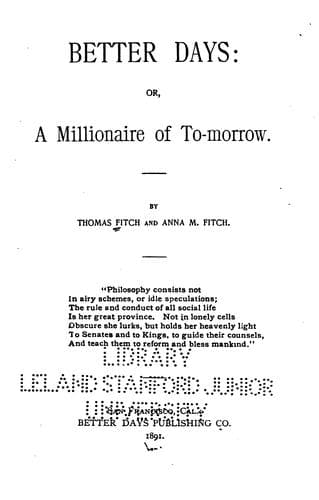
Better days; or, A Millionaire of To-morrowFitch, Thomas
Philosophy
Better days; or, A Millionaire of To-morrow
Fitch, Thomas
Utopias -- Fiction; West (U.S.) -- Fiction
“And caught more fish with our bamboo poles and angleworm bait than we
appear likely to capture to-day with this fancy tackle,” remarked the
doctor.
“Everything about this lovely little lake seems unchanged,” resumed the
professor, “but elsewhere the great world has indeed rolled on. Then
there were less than one hundred millionaires in this republic—now,
doctor, there are more than eight thousand.”
“And then,” said the doctor, “we came here in a rickety old stage wagon,
and we were ten hours in making the same journey which to-day we
achieved in an hour while seated in a parlor car. Then the telegraph was
in its infancy, the electric light was unknown, the great manufacturing
cities were unconstructed, the petroleum of Pennsylvania and the gold of
California and Australia were undiscovered, the great Western railroad
lines were unbuilt, and the web of complex industries with which the
land is now laced was unspun. The victim of a raging tooth or a crushed
limb was compelled to suffer without relief from chloroform or ether,
and it was a crime punishable with social ostracism to question the
righteousness of human slavery, the curative virtues of calomel, or the
beneficence of infant damnation. I never could think, John, that the
good old times, whose loss you are always bemoaning, were nearly so
comfortable times to live in as those amid which we now dwell.”
“Dr. Eustace,” said the professor, “you attach undue importance to a few
physical comforts and conveniences. If our fathers lacked the advantages
of our later civilization, they were also without its vices. In the good
old times which you deride, wrecking railroads, stealing railroads, and
watering stocks were unknown. Senatorships and subsidies were not
procured by bribery; the legislator who sold his vote made arrangements
to leave the country, and bank burglars and bank defaulters kept, in the
public estimation, the lock step of fellow-criminals.”
“And what, in your opinion was the cause of our descent from this high
estate of public virtue and whale-oil lamps?”
“The main cause, Dr., of the corruption of the human race
everywhere,—gold. It was the gold of California that revolutionized the
finances, the business methods, and the morals of the nation. After the
year 1849 the advance of values, the aggregation of wealth, the increase
of population, and the magical growth of the West, made additional
facilities for inland travel and transportation a necessity. This
necessity caused the rapid construction of new lines of railroad. The
differences and difficulties of local management suggested the
advantages of consolidation—and then the reign of the centripetal forces
commenced.”
“But all the millionaires of the country are not railroad men, John.”
Public-domain text, read in full here on John Shaqi.
Reviews
Reviews
No reviews yet
Be the first to share your thoughts on this work.
Join the Discussion
Join the discussion
Sign in to leave a comment or review.
Sign InorCreate an account