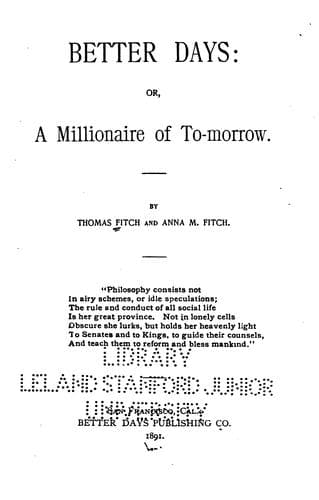
Better days; or, A Millionaire of To-morrowFitch, Thomas
Philosophy
Better days; or, A Millionaire of To-morrow
Fitch, Thomas
Utopias -- Fiction; West (U.S.) -- Fiction
“Concentration of capital began with them, doctor, and their example was
soon followed by others. The Civil War broke down local prejudices, made
East and West homogeneous, introduced communities to each other on the
battle-field, obliterated State lines, and made individual effort in
business, in finance, in manufactures, and even in politics, less
advantageous to the individual than participation in aggregated effort,
where his gains were increased, though his personality was submerged.”
“I have always thought that our civil war was a moral education to this
people and to the world,” remarked the doctor.
“War was an educator,” conceded the professor, “yet the tree of
knowledge with its crimson leaves yielded evil fruit as well as good.
The moral nature of the American people has, I fear, reacted from the
tension of generous and patriotic sacrifice which war evolved. Some of
the very men who helped to strike shackles from black slaves have been
busy ever since forging other shackles for white slaves, and in
twenty-five years from the days when we freely paid lives and treasure
to preserve the existence of the nation, and free it from the wrong of
slavery and the rule of a slave-holding oligarchy, we have passed under
the sway of other despots, more selfish, more sordid, more relentless,
and more rapacious of dominion. The dusk-browed tyrant of Egypt has been
overthrown, but in his place Plutus reigns.”
“I grant you,” interposed Dr. Eustace, “that the wealth owners are the
rulers of our later civilization, but, so far as I have observed,
instead of endeavoring to curb or overthrow them, we are all doing our
best to join their ranks and participate in their power. You appear to
be the only living millionaire who declaims against his class. I know of
no other man who is brave enough to defy the power of money, great
enough to ignore it, or strong enough to resist its influence, and I
dare say you would change your views if you were to lose your millions.
We all defer to the plutocrats. The Spanish nobleman who, for his
ancestor’s services, was permitted to remain with his head covered in
the presence of his sovereign, would have been sure to take off his hat
if he had entered the office of the president of a country bank, with a
view of negotiating a small loan on doubtful security. There was a great
truth inadvertently given to the world in the programme of a Fourth of
July procession, wherein it was announced that the line would end with
bankers in carriages, followed by citizens on foot.”
“This subservience to King Gold, and pursuit of his favors, must cease,
Dr. Eustace, or this republic will be lost. The people must be taught to
assume a more independent and manly attitude toward the owners of
money.”
Public-domain text, read in full here on John Shaqi.
Reviews
Reviews
No reviews yet
Be the first to share your thoughts on this work.
Join the Discussion
Join the discussion
Sign in to leave a comment or review.
Sign InorCreate an account