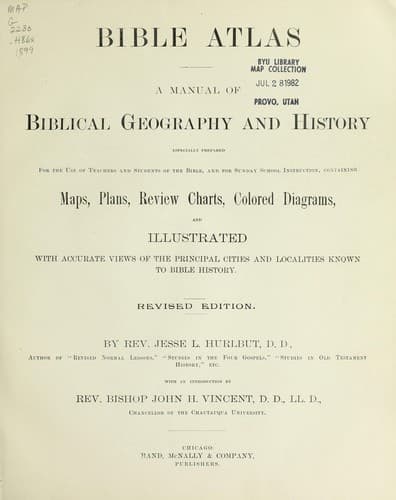
Bible Atlas: A Manual of Biblical Geography and HistoryHurlbut, Jesse Lyman
Religion
Bible Atlas: A Manual of Biblical Geography and History
Hurlbut, Jesse Lyman
Bible -- Geography; Bible -- Geography -- Maps; Bible -- History of Biblical events
1. _The Court_ was 150 feet long by 75 wide. It was separated from the
camp by a curtain of fine linen, supported by 60 pillars, of which 20
were on each side, and 10 on each end. The pillars were probably of wood
covered with brass. (There is strong reason for believing that the word
"brass" in the Old Testament refers to copper.) They were fastened
together by cords, and rested upon bases of brass, which were fastened
to the ground, perhaps by spikes from the bottom. Each pillar was 7-1/2
feet (5 cubits) high, and was covered with a silver cap. The curtain was
made of linen, in sections, extending from pillar to pillar, a distance
of about 8 feet, and was fastened to the pillars by hooks of silver. The
entrance was on the end toward the east, 30 feet wide, and consisted of
an embroidered hanging, which could be raised or lowered at pleasure.
None but the priests and Levites were allowed within the court; and the
worshipers presented their offerings without at the entrance. (Review.
1. Dimensions. 2. Pillars. 3. Curtain. 4. Entrance. 5. Priests.)
2. _The Altar_ stood within the court, in front of the entrance, in the
most prominent situation of the camp, and was the largest article of the
tabernacle furniture. It was a plain structure, 7-1/2 feet square and
4-1/2 feet high, hollow within, and made of acacia wood, to avoid
excessive weight; but covered with plates of brass, as it was exposed to
the fire. Upon each corner projected a horn from the top, upon which the
blood of the victim was sometimes sprinkled, and to which suppliants
sometimes fled. Around the altar, midway between the top and bottom, was
a "compass" (Exod. 27:5), or ledge, upon which the priest stood while
sacrificing. There is mention also of "a grate" (Exod. 27:4), which was
formerly supposed to have been placed inside the altar, so that the fire
might be built upon it, and the ashes fall through it; but this is now
by the best scholars considered to have been upright, and under the
"compass," and not a grate, but a lattice-work of brass, surrounding the
altar. It is believed that at each encampment the altar was filled with
earth, and that upon this the fire was kindled, according to Exod.
20:24, 25. At each corner was a brass ring, and through the pair of
rings on each side a rod was passed, by which the altar was carried
from place to place during the marches of Israel. The fire upon the
altar was kindled miraculously (Lev. 9:24), and was never suffered to go
out, but was kept alive even on the march by live coals in a vessel.
Twice each day the high-priest offered the general sacrifice for the
people, besides the individual offerings of worshipers. In officiating,
the priest approached the altar by an ascent of earth, as steps were
forbidden (Exod. 20:26), and he stood upon either the north or south
side, as the ashes were thrown out on the east side. (Lev. 1:16.) The
utensils of the altar were five, all of brass. 1. _Pans_, used to convey
the ashes outside the camp.
Public-domain text, read in full here on John Shaqi.
Reviews
Reviews
No reviews yet
Be the first to share your thoughts on this work.
Elsewhere in the archive
Join the Discussion
Join the discussion
Sign in to leave a comment or review.
Sign InorCreate an account