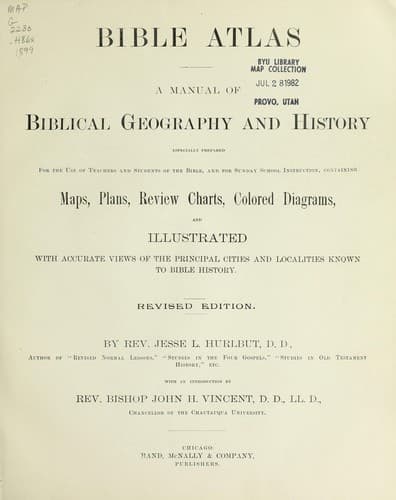
Bible Atlas: A Manual of Biblical Geography and History — John Shaqi
Bible Atlas: A Manual of Biblical Geography and HistoryHurlbut, Jesse Lyman
Religion
Bible Atlas: A Manual of Biblical Geography and History
Hurlbut, Jesse Lyman
Bible -- Geography; Bible -- Geography -- Maps; Bible -- History of Biblical events
To one familiar only with the habits, dress and customs of American
life, the every-day events recorded in the book seem fabulous. We do not
dress as the book says that people dressed in those far-away years and
far-away lands; we do not eat as they did; our houses are not like
theirs; we do not measure time as they did; we do not speak their
language; our seasons do not answer to the seasons that marked their
year. It is difficult, knowing only our modern American life, to _think_
ourselves into the conditions under which this book says that people
lived and thought in those long-ago ages. Their wedding feasts and
funeral services differed utterly from ours. They lived and died in
another atmosphere, under a government that no longer exists; made war
upon nations that are powerless to-day as the sleeping dead in a
national cemetery; and the things which we read concerning them seem
strange enough to us.
In the changes which have taken place through all these centuries, it
would be an easy thing, under some circumstances, for men to deny that
the people of the book ever lived, that the cities of the book were ever
built, that the events of the book ever transpired. And, if its historic
foundation were destroyed, the superstructure of truth, the doctrinal
and ethical teachings resting upon it, might in like manner be swept
away.
This old Book--the Bible, a divine product, wrought into the texture of
human history and literature with the gradually unfolding ages--is the
old Book we study to-day on this side the sea.
It is a "Book of books,"--the Book out-shining all other books in the
literary firmament, as the sun out-splendors the planets that move in
their orbits around him.
It is a book that deals with man as an immortal soul; making known the
beginnings of the race; going back of the beginning to God, who is from
"everlasting to everlasting," and who "in the beginning created the
heaven and the earth"; revealing the creative purpose and loving grace
of God; tracing the fall and deterioration of man, the divine
interposition in human history, the preparation of a family, a race, a
nation, and a world at large, for the coming of the Redeemer; revealing
the glory of God in the face of Jesus Christ; showing how the Christ
came, what he did, what he said, what he resisted, what he endured, what
he suffered, what he achieved; telling in simple way the story of the
early church, from the little meeting of the bereaved disciples in the
upper room to the magnificent consummation of Christ's coming, as seen
in the prophetic visions of St. John on the Isle of Patmos.
It is a book full of history, of geography, of archæology, of prophecy,
of poetry, of doctrine, of "exceeding great and precious promises."
Public-domain text, read in full here on John Shaqi.
Reviews
Reviews
No reviews yet
Be the first to share your thoughts on this work.
Join the Discussion
Join the discussion
Sign in to leave a comment or review.
Sign InorCreate an account