Bible Atlas: A Manual of Biblical Geography and History — John Shaqi
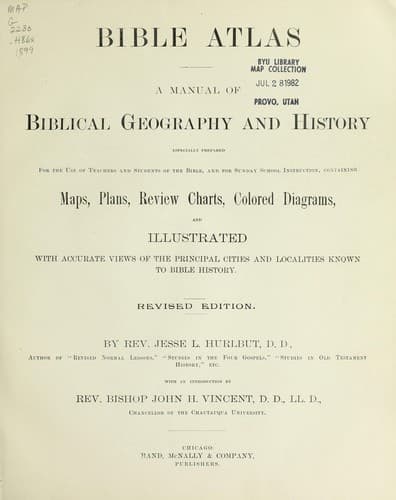
Bible Atlas: A Manual of Biblical Geography and HistoryHurlbut, Jesse Lyman
Religion
Bible Atlas: A Manual of Biblical Geography and History
Hurlbut, Jesse Lyman
Bible -- Geography; Bible -- Geography -- Maps; Bible -- History of Biblical events
In an important sense the foundations of this book are laid in human
history and geography. However high toward the heavens it may reach in
doctrine and promise, its foundations lay hold of the earth. If the
children of Israel did not live in Egypt and Canaan and the far East, if
the statements of their history as recorded in the book be not _facts_,
if the story of Jesus Christ be false,--everything fails us. With the
sweeping away of fact, we must also bid farewell to the words of
doctrine and of promise here recorded; to the divine words of assurance
which now give comfort to the penitent, hope to the despairing, strength
to the feeble, and immortal life to the dying.
As we sit down on this side of the sea, it is well that we are able to
look beyond the sea to the lands which gave to the world the book in our
hands. And it is well, that, as we look, we are able to connect the book
of to-day with those same lands as they now lie among the rivers and by
the seaside, from the sources of the Tigris and Euphrates to the mouths
of the Nile, from the palaces of Babylon to the dock at Puteoli and the
prison at Rome. And it is well that the lands as they are found to-day
correspond to the records of the Book as they were made centuries and
centuries ago. The Book, on its human historic, geographical and
archæological side, is true to the facts as in the nineteenth century
they are presented to us in the lands of the East.
There are those who believe with firm faith, that, for these days of
skepticism and of merciless and conscienceless historic criticism, the
lands have been kept almost in their original condition, that the
testimony of the modern skeptical traveler might (though unintentionally
on his part, but necessarily) corroborate the teachings of the Bible.
Have the mummy wrappings of Mohammedan domination held the far East
unchanged through the centuries, that in these days of doubt the hills
of Canaan, the plains of Egypt and the ruins of Mesopotamia might lift
their voice in solemn attestation to the divine truthfulness of the
sacred historians?
These lands are memorial lands. They are now what the Book says they
once were. Although the sweeping away of ancient governments and the
reign of anarchy have modified the face of the country, the evidences
still remain that the most glowing descriptions of their prosperity were
not exaggerated. Infidels have doubted, for example, whether Palestine
could contain the immense populations which, in its prosperous days,
according to the statements of the Book, were resident there. But
scientists show that the soil of Canaan, under cultivation, is one of
the richest and most fertile in the world. The broken terraces that may
still be traced on the hill-sides, the walls of cities and other ruins
that fill the land, sustain the account of the prosperous days and the
immense populations of Bible times.
Public-domain text, read in full here on John Shaqi.
Reviews
Reviews
No reviews yet
Be the first to share your thoughts on this work.
Join the Discussion
Join the discussion
Sign in to leave a comment or review.
Sign InorCreate an account