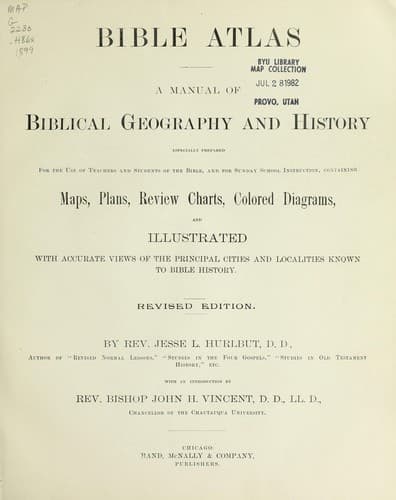
Bible Atlas: A Manual of Biblical Geography and History — John Shaqi
Bible Atlas: A Manual of Biblical Geography and HistoryHurlbut, Jesse Lyman
Religion
Bible Atlas: A Manual of Biblical Geography and History
Hurlbut, Jesse Lyman
Bible -- Geography; Bible -- Geography -- Maps; Bible -- History of Biblical events
Bible History 14, 15
Chronological Chart of Kings of Israel and Judah 87
Paul's First Journey, Review 119
Table of Nations, Review 27
COMPARATIVE DIAGRAMS.
Age of the Patriarchs, before and after the Deluge 34
Areas of Asia Minor and Texas, U.S. 118
Area of Egypt 42
Areas of Palestine and New England 29
Area of Palestine at Different Periods 70
Areas of Assyrian, Babylonian and Persian Empires 93
Height of Bible Mountains 17
Height of Mountains in Palestine 32
Population of the Twelve Tribes at Entrance into
Canaan 57
Size of the Territory of the Tribes 56
United States and Old Testament World 17
PLANS.
Antioch, Ancient 114
Athens, Ancient 122
Babylon 93
Camp of Israel 47
Ephesus and Vicinity 125
Rome, Ancient 129
Sacred Enclosure (Herod's Temple) 141
Section of Palestine, North to South 31
Section of Palestine, East to West 31
Section Through the Middle of Temple, East to West 140
Solomon's Temple 71
Temple in the Time of Christ (Herod's) 138
[Illustration: ENTRY OF PILGRIMS INTO BETHLEHEM.]
CHART OF BIBLE HISTORY.
THE Geography and the History of the Bible are so closely united that
neither subject can be studied to advantage without the other. We
therefore present at the opening of our work the Chart of Bible History,
upon which the leading events of Bible History and those of the ancient
world in general are arranged in parallel columns. The blue lines
extending across the page represent the centuries before Christ, each
space between them being 100 years. Until recently the common chronology
found in all reference Bibles and Biblical works, was that prepared by
Archbishop Ussher, who died in 1656, long before the present sources of
information from "the monuments" had been discovered. His chronology has
not been regarded as trustworthy by scholars for thirty years past; but
until recently it has been retained because students of Biblical and
Ancient History were not agreed as to the dates which should be given in
place of it. But there is now a substantial, though not complete
agreement among scholars; and we therefore discard the Ussherian system,
and adopt that obtained from the information given in the inscriptions
of Assyria, Babylonia, and Egypt, when compared with statements in the
Bible.
Public-domain text, read in full here on John Shaqi.
Reviews
Reviews
No reviews yet
Be the first to share your thoughts on this work.
Join the Discussion
Join the discussion
Sign in to leave a comment or review.
Sign InorCreate an account