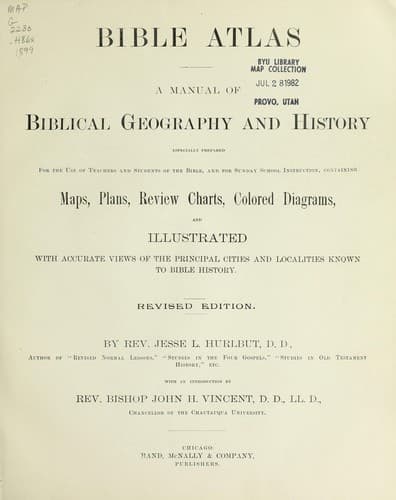
Bible Atlas: A Manual of Biblical Geography and HistoryHurlbut, Jesse Lyman
Religion
Bible Atlas: A Manual of Biblical Geography and History
Hurlbut, Jesse Lyman
Bible -- Geography; Bible -- Geography -- Maps; Bible -- History of Biblical events
We begin at the date 2500 B.C. as the events of Bible History earlier
than 2500 B.C. cannot be fixed with any certainty. And it must be
admitted that none of the dates earlier than 1000 B.C. can be regarded
as established.
I. =General Periods.= In the first column we note the five great periods
of Bible History. These are the natural divisions of the events
contained in the Bible story.
1. The Period of the Early Races, from the Deluge, at a date unknown, to
the Call of Abraham, B.C. 2280. Before the Call of Abraham, the history
in the book of Genesis is introductory.
2. The Period of the Chosen Family, from the Call of Abraham, B.C. 2280,
to the Exodus from Egypt, about 1250 B.C.
3. The Period of the Israelite People, from the Exodus, 1250 B.C., to
the Coronation of Saul, about 1050 B.C.
4. The Period of the Israelite Kingdom, from the Coronation of Saul,
1050 B.C., to the Captivity in Babylon, B.C. 587.
5. The Period of the Jewish Province, from the Captivity in Babylon, 587
B.C., to the Destruction of Jerusalem by the Romans, A.D. 70.
II. In the second column the larger periods are broken up into
=Subdivisions=. 1. In the _Period of the Early Races_ the line of
division is made at the Dispersion of the Races, to which no date is
assigned. 2. _The Period of the Chosen Family_ is subdivided at the
Descent into Egypt by Jacob and his family, about 2060 B.C. 3. _The
Period of the Israelitish People_ has three subdivisions. (1.) The
Wandering in the Wilderness, from the Exodus, B.C. 1250, to the Entrance
into Canaan, B.C. 1210. (2.) The Settlement, extending to the
Mesopotamian Oppression, B.C. 1180. (3.) The Rule of the Judges, to the
Coronation of Saul, B.C. 1050. 4. _The Period of the Israelitish
Kingdom_ naturally divides itself into three sections. (1.) Unity, to
the Division of the Kingdom, B.C. 935. (2.) Division, to the Captivity
of the Ten Tribes, B.C. 721. (3.) Decay, the stage of the kingdom of
Judah alone, from B.C. 721 to 587, the Babylonian Captivity. 5. _The
Period of the Jewish Province_ has five subdivisions. (1.) Chaldean
Rule, to the Return from Captivity, B.C. 536. (2.) Persian Rule, to the
Conquest by Alexander the Great, B.C. 330. (3.) Greek Rule, under the
kingdoms of Alexander's successors to the Revolt of Mattathias, B.C.
168. (4.) Jewish Independence, to the Annexation of Judæa to the Roman
Empire, A.D. 6. (5.) Roman Rule, to the final Destruction of Jerusalem,
A.D. 70.
III. Next, we notice the prominent =Persons and Rulers= in Sacred
History. The perpendicular lines opposite the names of the patriarchs
indicate the duration of their lives, according to the common
chronology. Only the most important of the Judges are named, and with
each is given his number in the order of the list. The crowns show the
kings, and the years show the period of their reigns. The chronology
during the age of the Judges is very uncertain, and the dates are only
conjectural.
Public-domain text, read in full here on John Shaqi.
Reviews
Reviews
No reviews yet
Be the first to share your thoughts on this work.
Join the Discussion
Join the discussion
Sign in to leave a comment or review.
Sign InorCreate an account