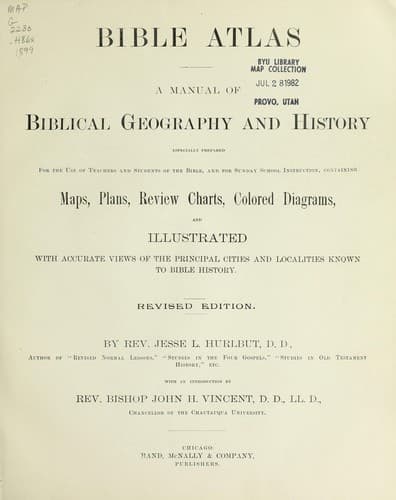
Bible Atlas: A Manual of Biblical Geography and History — John Shaqi
Bible Atlas: A Manual of Biblical Geography and HistoryHurlbut, Jesse Lyman
Religion
Bible Atlas: A Manual of Biblical Geography and History
Hurlbut, Jesse Lyman
Bible -- Geography; Bible -- Geography -- Maps; Bible -- History of Biblical events
IV. =The Events of Bible History=, given in the fourth column, are too
numerous to be recapitulated. The student should divide them according
to the Subdivisions of the Periods, already given.
V. =The History of Egypt= occupies the fifth column. The opinions of
scholars are greatly at variance with regard to the dates of the first
eighteen dynasties, some of them differing by a thousand years. The
ancient history of Egypt is divided into three sections. (1.) The Old
Kingdom, founded by Menes perhaps 4700 B.C., and governed by ten
dynasties in succession. (2.) The Middle Kingdom, from about 2900 B.C.
to 1570 B.C., Dynasties XI. to XVII. (3.) The New Kingdom, from 1570
B.C. to 525 B.C., Dynasties XVII. to XXVII. Egypt was part of the Persian
Empire from 525 to 332 B.C. After 323 B.C. it was governed by a line of
Greek kings, who bore the name of Ptolemy, until 30 B.C., when it became
a Roman province.
VI. =The Kingdoms of the East=, Babylonia and Assyria, appear on the
sixth column; beginning with a number of states in Babylonia; becoming
an empire under Hammurabi about 2280 B.C.; by turns strong and weak
until about 1100 B.C., when the Assyrian empire arose, overpowering
Babylon. The Assyrian Empire lasted until 625 B.C., when Babylon again
arose to power, though the Chaldean Empire did not begin until 606 B.C.
In 536 B.C. it fell before the Persian conquerors, and the whole world
of the Bible was under Persian control until 330 B.C., when Alexander
the Great won it. No world-empire arose after the death of Alexander,
until the Roman period.
[Transcriber's Note: This time-line has been changed from the original
layout due to width and text constraints. Originally, there were eight
columns across with the Roman numeral major divisions noted below and
the century marks ran down the left and right margins. The original is
also color-coded to indicate eras of history such as the Roman Rule of
Israel. To try to make this time-line still useful in a text format,
each item from each column has been arranged in order with a letter
indicating its original column title. This leads to some necessary
repetion. For example:
[C] c. 1010. David, King.
[D] 1010--David King over Judah.
because David was both a "Ruler in Bible History" and a part of the
"History of Israel." Below this linear timeline is a format more like
the original but with only one, two or three columns in a section
depending on the space available.]
A I. General Periods
B II. Subdivision of General Periods
C III. Persons and Rulers in Bible History
D IV. History of Israel
E V. Egypt
F VI. Kingdoms of the East
G VII. The Oriental Empires
H VIII. The World in General
Public-domain text, read in full here on John Shaqi.
Reviews
Reviews
No reviews yet
Be the first to share your thoughts on this work.
Join the Discussion
Join the discussion
Sign in to leave a comment or review.
Sign InorCreate an account