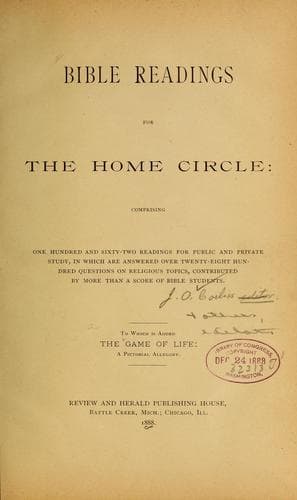
Bible -- Illustrations; Bible -- Indexes; Bible -- Study and teaching
The New Testament was all originally written in Greek, except Matthew,
which was first written in Hebrew, and later translated into Greek.
[Illustration.]
Gutenberg Printing The Bible
At an early date, Latin translations, both of the Septuagint and of the
Greek New Testament, were made by different individuals, and the more
carefully prepared Latin Vulgate of Jerome, the Bible complete, was made
A.D. 383-405.
Printing and the Bible
Printing, however, being yet unknown, copies of the Bible could be
produced only by the slow, laborious, and expensive process of
handwriting. This necessarily greatly limited its circulation. Worse
still, its illuminating and saving truths were largely hidden for
centuries by the errors, superstitions, and apostasy of the dark ages.
During this time the common people knew little of its contents.
But with the invention of the art of printing about the middle of the
fifteenth century, and with the dawn of the great Reformation in the
century following, the Bible entered upon a new era, preparatory to the
final proclamation of the gospel throughout the world.
[Illustration.]
Luther Translating The Bible
Not a little significant is the fact that the first book printed from
movable type was the Bible in Latin, which came from the press of John
Gutenberg, at Mentz, Germany, in 1456, a copy of which, in 1911, was sold
in New York City for fifty thousand dollars, the highest price ever paid
for a single book.
The Bible in Native Tongues
Thus far, however, the Bible had been published only in ancient tongues,
now little understood by the common people. Without the Word of God in
their hands, the good seed sown among them was easily destroyed. “O,” said
the advocates of its pure teachings, “if the people only had the Word of
God in their own language, this would not happen! Without this it will be
impossible to establish the laity in the truth.”
And why should they not have it in their own tongue? they reasoned. Moses
wrote in the language of the people of his time; the prophets spoke in the
tongue familiar to the men whom they addressed; and the New Testament was
written in the language then current throughout the Roman world.
The translation of the Bible into English by John Wyclif, in 1380, was the
chief event in the beginning of the Reformation. It also prepared the way
for the revival of Christianity in England, and the multiplying there of
the Word by the millions, for all the world, that has followed.
Public-domain text, read in full here on John Shaqi.
Reviews
Reviews
No reviews yet
Be the first to share your thoughts on this work.
Join the Discussion
Join the discussion
Sign in to leave a comment or review.
Sign InorCreate an account