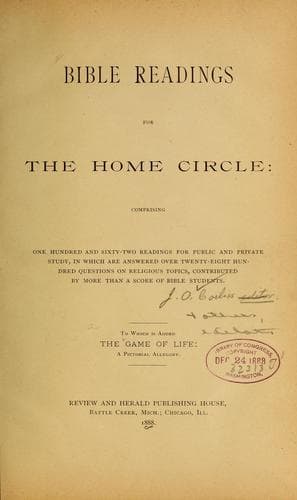
Bible -- Illustrations; Bible -- Indexes; Bible -- Study and teaching
To make such a translation at that time, says Neander, “required a bold
spirit which no danger could appal.” For making it Wyclif was attacked
from various quarters, because, it was claimed, “he was introducing among
the multitude a book reserved exclusively for the use of the priests.” In
the general denunciation it was declared that “thus was the gospel by him
laid more open to the laity, and to women who could read, than it had
formerly been to the most learned of the clergy; and in this way the
gospel pearl is cast abroad, and trodden underfoot of swine.” In the
preface to his translation, Wyclif exhorted all the people to read the
Scriptures.
A sense of awe and a thrill of joy filled the heart of the great German
Reformer, when, at the age of twenty, while examining the volumes in the
library of the university of Erfurt, he held in his hands, for the first
time in his life, a complete copy of the Bible. “O God,” he murmured,
“could I but have one of these books, I would ask no other treasure.” A
little later he found in a convent a chained Bible. To this he had
constant recourse.
But all these Bibles here, as elsewhere, save in England, were in an
ancient tongue, and could be read only by the educated. Why, thought
Luther, should the living Word be confined to dead languages? Like Wyclif,
therefore, he resolved to give his countrymen the Bible in their own
tongue. This he did, the New Testament in 1522, and the Bible complete,
the crowning work of his life, in 1534.
Impressed with the idea that the people should read the Scriptures in
their mother tongue, William Tyndale, likewise, in 1525, gave to the
English his translation of the New Testament, and later, of portions of
the Old Testament Scriptures. His ardent desire that they should know the
Bible was well expressed in the statement that if God spared his life he
would cause the boy that drives the plow to know more of the Scriptures
than was commonly known by the divines of his day.
The first complete printed English Bible was that of Miles Coverdale,
printed at Zurich, Switzerland, in 1535. Matthew’s Bible, Taverner’s
Bible, and The Great Bible prepared at the suggestion of Thomas Cromwell,
Earl of Essex, appeared soon after. Thus the light of truth began to shine
forth once more; but not without opposition.
Burning of Bibles
As Jehoiakim, king of Judah, and the princes under King Zedekiah showed
their contempt for God by burning the writings of Jeremiah, and confining
the prophet in a dungeon (Jer. 36:20-23; 38:1-6), so now men sought to
stem the rising tide of reform by burning the Bible and its translators.
Bible burning was inaugurated in England by the destruction of copies of
the Antwerp edition of Tyndale’s New Testament, at St. Paul’s Cross,
London, in 1527, followed by the burning of a second edition in 1530. A
little later there were wholesale burnings of the writings and
translations of Wyclif, Tyndale, Basil, Barnes, Coverdale, and others.
Public-domain text, read in full here on John Shaqi.
Reviews
Reviews
No reviews yet
Be the first to share your thoughts on this work.
Join the Discussion
Join the discussion
Sign in to leave a comment or review.
Sign InorCreate an account