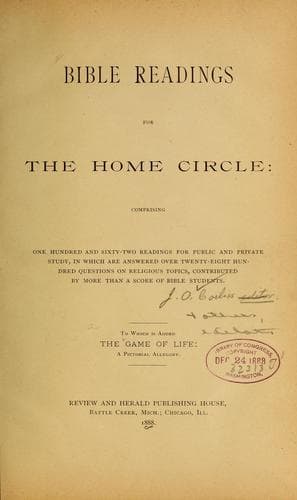
Bible -- Illustrations; Bible -- Indexes; Bible -- Study and teaching
[Illustration.]
Burning Of Bibles At St. Paul’s Cross, London
Forty-three years after the death of Wyclif, or in A.D. 1428, by order of
the Council of Constance his bones were dug up and burned. Oct. 6, 1536,
by order of Charles V of Germany, Tyndale was strangled and burned at the
stake at Vilvorde, near Brussels. “If Luther will not retract,” wrote
Henry VIII of England, “let himself and his writings be committed to the
flames.”
Such, under the spiritual tyranny that ruled in those times, was the fate
of many who stood for God and His Word.
The Word Not Bound
But the Word of God could not be forever bound. In attempting to prevent
its circulation men soon discovered that they were undertaking a work
beyond their strength.
The Bible had taken deep root in the hearts of the people. What kings and
prelates had sought to suppress and destroy, kings and prelates now began
to foster and supply.
In his “Stories From English History,” pages 196, 197, Henry P. Warren
says: “Henry, by Cromwell’s advice, ordered a translation of the Bible to
be made in English, and a copy to be placed in every church. There had
been English translations before, but they had not been in the hands of
the people generally, and had only been read secretly and in fear....
Cromwell then appointed Cranmer and the bishops to revise the Bible, and
publish it without note or comment; and in the year 1539 a copy of the
English Bible was chained to the reading-desk of every parish church. From
that time the Bible has never ceased to be printed and sold freely.”
[Illustration.]
The Chained Bible
Says Charles C. Coffin, in his “Story of Liberty,” page 44: “The people
listen to the reading with wonder and delight. They begin to think; and
when men begin to think, they take a step toward freedom. They see that
the Bible gives them rights which hitherto have been denied them,—the
right to read, to acquire knowledge. Schools are started. Men and women
who till now have not known a letter of the alphabet, learn to read;
children teach their parents. It is the beginning of a new life, a new
order of things in the community—the beginning of liberty.”
The Bible to All the World
Finally great Bible societies were organized in England, America, and many
of the countries of Europe, for the purpose of giving the Bible to the
world,—to every nation, kindred, tongue, and people in its own language.
Since its organization in 1804, the British and Foreign Bible Society, up
to 1912, had published the Scriptures, or portions of them in 440
languages and dialects, with a total of 53,274,516 entire Bibles,
84,059,610 New Testaments, and 89,816,644 portions of the Bible, or a
grand total of 227,150,770 copies.
[Illustration.]
British And Foreign Bible Society House, London
Public-domain text, read in full here on John Shaqi.
Reviews
Reviews
No reviews yet
Be the first to share your thoughts on this work.
Join the Discussion
Join the discussion
Sign in to leave a comment or review.
Sign InorCreate an account