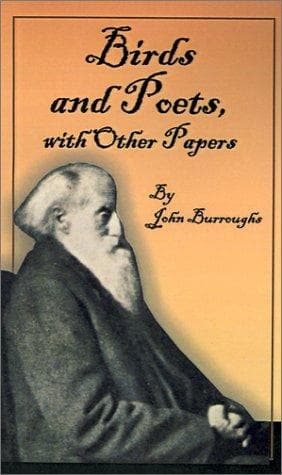
Birds and Poets : with Other PapersBurroughs, John
History
Birds and Poets : with Other Papers
Burroughs, John
American essays -- 19th century; Birds; Natural history -- Outdoor books; Nature
At the approach of the breeding season the bobolink undergoes a complete
change; his form changes, his color changes, his flight changes. From
mottled brown or brindle he becomes black and white, earning, in some
localities, the shocking name of "skunk bird;" his small, compact form
becomes broad and conspicuous, and his ordinary flight is laid aside for
a mincing, affected gait, in which he seems to use only the very tips of
his wings. It is very noticeable what a contrast he presents to his mate
at this season, not only in color but in manners, she being as shy and
retiring as he is forward and hilarious. Indeed, she seems disagreeably
serious and indisposed to any fun or jollity, scurrying away at his
approach, and apparently annoyed at every endearing word and look. It
is surprising that all this parade of plumage and tinkling of cymbals
should be gone through with and persisted in to please a creature so
coldly indifferent as she really seems to be. If Robert O'Lincoln has
been stimulated into acquiring this holiday uniform and this musical
gift by the approbation of Mrs. Robert, as Darwin, with his sexual
selection principle, would have us believe, then there must have been
a time when the females of this tribe were not quite so chary of their
favors as they are now. Indeed, I never knew a female bird of any kind
that did not appear utterly indifferent to the charms of voice and
plumage that the male birds are so fond of displaying. But I am inclined
to believe that the males think only of themselves and of outshining
each other, and not at all of the approbation of their mates, as, in an
analogous case in a higher species, it is well known whom the females
dress for, and whom they want to kill with envy!
I know of no other song-bird that expresses so much self-consciousness
and vanity, and comes so near being an ornithological coxcomb. The
red-bird, the yellowbird, the indigo-bird, the oriole, the cardinal
grosbeak, and others, all birds of brilliant plumage and musical
ability, seem quite unconscious of self, and neither by tone nor act
challenge the admiration of the beholder.
By the time the bobolink reaches the Potomac, in September, he has
degenerated into a game-bird that is slaughtered by tens of thousands in
the marshes. I think the prospects now are of his gradual extermination,
as gunners and sportsmen are clearly on the increase, while the limit of
the bird's productivity in the North has no doubt been reached long ago.
There are no more meadows to be added to his domain there, while he is
being waylaid and cut off more and more on his return to the South.
It is gourmand eat gourmand, until in half a century more I expect the
blithest and merriest of our meadow songsters will have disappeared
before the rapacity of human throats.
Public-domain text, read in full here on John Shaqi.
Reviews
Reviews
No reviews yet
Be the first to share your thoughts on this work.
Join the Discussion
Join the discussion
Sign in to leave a comment or review.
Sign InorCreate an account