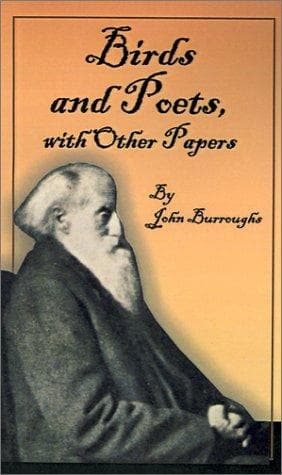
Birds and Poets : with Other PapersBurroughs, John
History
Birds and Poets : with Other Papers
Burroughs, John
American essays -- 19th century; Birds; Natural history -- Outdoor books; Nature
We have no well-known pastoral bird in the Eastern States that answers
to the skylark. The American pipit or titlark and the shore lark, both
birds of the far north, and seen in the States only in fall and winter,
are said to sing on the wing in a similar strain. Common enough in our
woods are two birds that have many of the habits and manners of the
lark--the water-thrush and the golden-crowned thrush, or oven-bird. They
are both walkers, and the latter frequently sings on the wing up aloft
after the manner of the lark. Starting from its low perch, it rises in
a spiral flight far above the tallest trees, and breaks out in a clear,
ringing, ecstatic song, sweeter and more richly modulated than the
skylark's, but brief, ceasing almost before you have noticed it; whereas
the skylark goes singing away after you have forgotten him and returned
to him half a dozen times.
But on the Great Plains, of the West there; is a bird whose song
resembles the skylark's quite closely and is said to be not at all
inferior. This is Sprague's pipit, sometimes called the Missouri
skylark, an excelsior songster, which from far up in the transparent
blue rains down its notes for many minutes together. It is, no doubt,
destined to figure in the future poetical literature of the West.
Throughout the northern and eastern parts of the Union the lark would
find a dangerous rival in the bobolink, a bird that has no European
prototype, and no near relatives anywhere, standing quite alone, unique,
and, in the qualities of hilarity and musical tintinnabulation, with
a song unequaled. He has already a secure place in general literature,
having been laureated by no less a poet than Bryant, and invested with a
lasting human charm in the sunny page of Irving, and is the only one of
our songsters, I believe, that the mockingbird cannot parody or imitate.
He affords the most marked example of exuberant pride, and a glad,
rollicking, holiday spirit, that can be seen among our birds. Every note
expresses complacency and glee. He is a beau of the first pattern, and,
unlike any other bird of my acquaintance, pushes his gallantry to the
point of wheeling gayly into the train of every female that comes along,
even after the season of courtship is over and the matches are all
settled; and when she leads him on too wild a chase, he turns, lightly
about and breaks out with a song is precisely analogous to a burst of
gay and self-satisfied laughter, as much as to say, _"Ha! ha! ha! I
must have my fun, Miss Silverthimble, thimble, thimble, if I break every
heart in the meadow, see, see, see!"_
Public-domain text, read in full here on John Shaqi.
Reviews
Reviews
No reviews yet
Be the first to share your thoughts on this work.
Join the Discussion
Join the discussion
Sign in to leave a comment or review.
Sign InorCreate an account