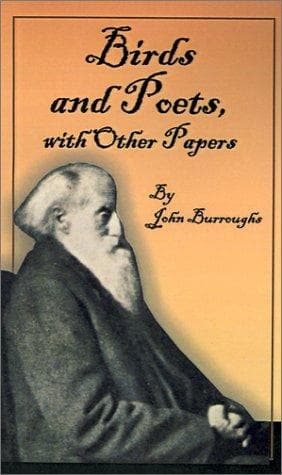
Birds and Poets : with Other PapersBurroughs, John
History
Birds and Poets : with Other Papers
Burroughs, John
American essays -- 19th century; Birds; Natural history -- Outdoor books; Nature
"For so I found my forest bird,--
The pewee of the loneliest woods,
Sole singer in these solitudes,
Which never robin's whistle stirred,
Where never bluebird's plume intrudes.
Quick darting through the dewy morn,
The redstart trilled his twittering horn
And vanished in thick boughs; at even,
Like liquid pearls fresh showered from heaven,
The high notes of the lone wood thrush
Fell on the forest's holy hush;
But thou all day complainest here,--
'Pe-wee! pe-wee! peer!'"
Emerson's best natural history poem is the "Humble-Bee,"--a poem as
good in its way as Burns's poem on the mouse; but his later poem,
"The Titmouse," has many of the same qualities, and cannot fail to be
acceptable to both poet and naturalist.
The chickadee is indeed a truly Emersonian bird, and the poet shows him
to be both a hero and a philosopher. Hardy, active, social, a winter
bird no less than a summer, a defier of both frost and heat, lover of
the pine-tree, and diligent searcher after truth in the shape of eggs
and larvae of insects, preeminently a New England bird, clad in black
and ashen gray, with a note the most cheering and reassuring to be
heard in our January woods,--I know of none other of our birds so well
calculated to captivate the Emersonian muse.
Emerson himself is a northern hyperborean genius,--a winter bird with
a clear, saucy, cheery call, and not a passionate summer songster.
His lines have little melody to the ear, but they have the vigor and
distinctness of all pure and compact things. They are like the needles
of the pine--"the snow loving pine"--more than the emotional foliage of
the deciduous trees, and the titmouse becomes them well:--
"Up and away for life! be fleet!--
The frost-king ties my fumbling feet,
Sings in my ears, my hands are stones,
Curdles the blood to the marble bones,
Tugs at the heart-strings, numbs the sense,
And hems in life with narrowing fence.
Well, in this broad bed lie and sleep,--
The punctual stars will vigil keep,--
Embalmed by purifying cold;
The wind shall sing their dead march old,
The snow is no ignoble shroud,
The moon thy mourner, and the cloud.
"Softly,--but this way fate was pointing,
'T was coming fast to such anointing,
When piped a tiny voice hard by,
Gay and polite, a cheerful cry,
_Chick-chickadeedee!_ saucy note,
Out of sound heart and merry throat,
As if it said 'Good day, good sir!
Fine afternoon, old passenger!
Happy to meet you in these places,
Where January brings few faces.'
Public-domain text, read in full here on John Shaqi.
Reviews
Reviews
No reviews yet
Be the first to share your thoughts on this work.
Join the Discussion
Join the discussion
Sign in to leave a comment or review.
Sign InorCreate an account